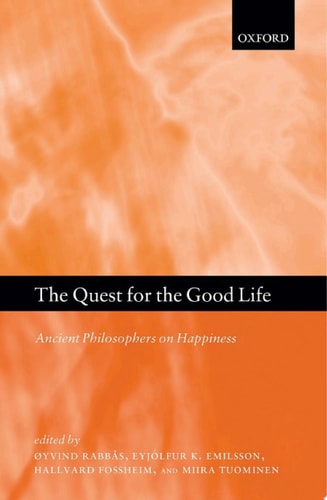
The Quest for the Good Life: Ancient Philosophers on Happiness
0
0
As an Amazon Associate and affiliate partner, Menrva Books earns from qualifying purchases. Learn more
Author Description
How should I live? How can I be happy? What is happiness, really? These are perennial questions, which in recent times have become the object of diverse kinds of academic research. Ancient philosophers placed happiness at the centre of their thought, and we can trace the topic through nearly a millennium. While the centrality of the notion of happiness in ancient ethics is well known, this book is unique in that it focuses directly on this notion, as it appears in the ancient texts. Fourteen papers by an international team of scholars map the various approaches and conceptions found from the Pre-Socratics through Plato, Aristotle, Hellenistic Philosophy, to the Neo-Platonists and Augustine in late antiquity. While not promising a formula that can guarantee a greater share in happiness to the reader, the book addresses questions raised by ancient thinkers that are still of deep concern to many people today: Do I have to be a morally good person in order to be happy? Are there purely external criteria for happiness such as success according to received social norms or is happiness merely a matter of an internal state of the person? How is happiness related to the stages of life and generally to time? In this book the reader will find an informed discussion of these and many other questions relating to happiness.
Menrva's Summary
THE THESIS
This collection of academic papers investigates the core question of how ancient philosophers defined and pursued the concept of happiness. The authors, a team of international scholars, utilize a historical framework to analyze primary texts from the Pre-Socratics through the Neo-Platonists. By examining the evolution of ethical thought, the book argues that ancient inquiries into the nature of the 'good life' remain relevant to contemporary existential concerns regarding morality, external success, and the passage of time.
THE SCOPE MAP
What You Will Find
- A chronological survey of happiness theories from Pre-Socratics, Plato, and Aristotle to Hellenistic thinkers and Augustine.
- Analysis of the relationship between moral virtue and personal well-being.
- Examination of the role of external social norms versus internal psychological states.
Scope Limits
- The text does not provide a practical self-help formula or a guide for achieving personal happiness.
- It focuses strictly on historical and philosophical analysis rather than modern psychological or sociological data.
THE AUTHORITY PERSPECTIVE
Scholars and students of classical philosophy frequently cite this collection as a rigorous, multi-faceted resource for understanding the development of ancient ethics. Readers often note the academic density of the prose, which is intended for those with a background in philosophical discourse.
Page Count:
317
Publication Date:
2015-01-01
Publisher:
OUP Oxford
ISBN-10:
0191064025
ISBN-13:
9780191064029
Non-Fiction
History
Philosophy
History & Surveys
Ancient History
Ethics
Community Tags
Similar Books