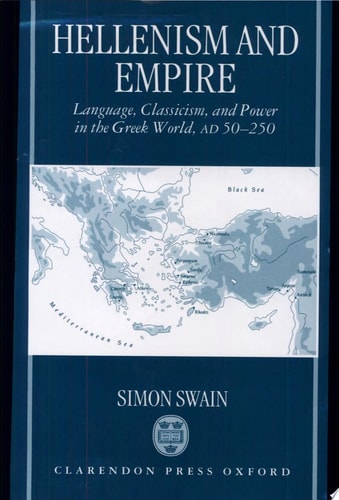
Hellenism and Empire: Language, Classicism, and Power in the Greek World, AD 50-250
0
0
As an Amazon Associate and affiliate partner, Menrva Books earns from qualifying purchases. Learn more
Author Description
Hellenism and Empire explores identity, politics, and culture in the Greek world of the first three centuries AD, the period known as the second sophistic. The sources of this identity were the words and deeds of classical Greece, and the emphasis placed on Greekness and Greek heritage was far greater then than at any other time. Yet this period is often seen as a time of happy consensualism between the Greek and Roman halves of the Roman Empire. The first part of the book shows that Greek identity came before any loyalty to Rome (and was indeed partly a reaction to Rome), while the views of the major authors of the period, which are studied in the second part, confirm and restate the prior claims of Hellenism.
Menrva's Summary
THE THESIS
This book investigates how the Greek-speaking population of the Roman Empire constructed and maintained a distinct cultural identity during the first three centuries AD. Simon Swain, a scholar from All Souls College, Oxford, utilizes a wide array of literary and historical sources to challenge the notion of a harmonious 'Graeco-Roman' consensus. He argues that Hellenism functioned as a primary, often reactive, loyalty that preceded political allegiance to Rome, shaping the intellectual and social output of the era's elite.
THE SCOPE MAP
What You Will Find
- Analysis of the 'Second Sophistic' period spanning AD 50-250.
- Examination of major Greek authors, rhetors, and philosophers of the era.
- Exploration of the tension between Greek cultural heritage and Roman political domination.
- Discussion of how language and classicism were used as tools of social and political power.
THE AUTHORITY PERSPECTIVE
Experts and reviewers recognize this work as a foundational text for understanding the intellectual climate of the Roman East. Readers frequently note the academic density of the prose, which provides a rigorous social analysis of the period's literature and political dynamics.
Page Count:
512
Publication Date:
1996-07-25
Publisher:
Oxford University Press
ISBN-10:
0198147724
ISBN-13:
9780198147725
History
Political History
Criticism history
Cultural History
Power Social sciences
Ancient Greece
Roman Empire
Community Tags
Similar Books