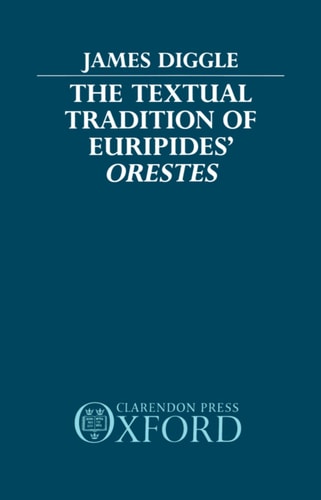
The Textual Tradition of Euripides' Orestes
0
0
As an Amazon Associate and affiliate partner, Menrva Books earns from qualifying purchases. Learn more
Author Description
Orestes, produced in 408 BC near the end of Euripides' life, was one of the most popular Greek tragedies and consequently was preserved in a large number of medieval manuscripts. Based on close scrutiny of the sixty most important, this book explains the complicated relationships that existed between them and reexamines the contribution made by the papyri and quotations that preserve parts of the play. Offering important new insights into problems of text and interpretation, meter, and the activities of Byzantine scholars, this important book will be indispensable to all students of the transmission of Greek tragedy and the transmission of classical texts in general.
Menrva's Summary
THE THESIS
This work investigates the complex manuscript tradition of Euripides' Orestes to clarify the transmission history of Greek tragedy. James Diggle, a noted classical scholar, utilizes a rigorous examination of sixty primary medieval manuscripts alongside papyrological evidence and ancient quotations. By analyzing these sources, the author constructs a framework for understanding how the text of the play evolved and was altered by Byzantine scholars over centuries.
THE SCOPE MAP
What You Will Find
- A detailed analysis of sixty significant medieval manuscripts of Orestes.
- An evaluation of papyri and ancient citations as textual witnesses.
- Methodological insights into the study of textual criticism and transmission.
- Examination of the editorial interventions performed by Byzantine scholars.
THE AUTHORITY PERSPECTIVE
Scholars and students of classical philology regard this work as a foundational resource for understanding the transmission of Greek texts. The text is noted for its technical precision and its significant contribution to the study of Euripidean scholarship.
Page Count:
198
Publication Date:
1991-09-12
Publisher:
Clarendon Press
ISBN-10:
019814766X
ISBN-13:
9780198147664
Drama
History
Literary Criticism
Philology
Community Tags
Similar Books