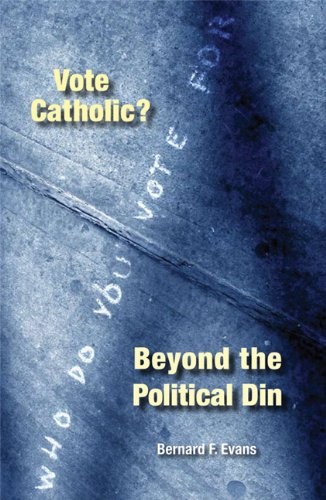
Vote Catholic?
0
0
As an Amazon Associate and affiliate partner, Menrva Books earns from qualifying purchases. Learn more
Author Description
This effort to bring clarity to the question of how Catholics should vote is aimed at dispelling the notion that certain issues—abortion in particular—carry more weight than others when Catholics cast their ballots. Evans, who holds a chair in rural social ministries at St. John's School of Theology in Collegeville, Minn., begins by saying that religion and politics can and do mix. However, he insists that focusing on a limited number of issues distorts overall Catholic teaching on the subject of voting. He suggests that Catholics take a wider view by considering such things as the living wage, capital punishment, health care, education, immigration, housing and public assistance, all of which he sees as related to the church's strong position in defense of the dignity of human life. Evans bases his premise on Catholic social teaching and cites various church documents, including statements of the U.S. Conference of Catholic Bishops. This teaching, he posits, invites consideration of the needs of the larger community, the protection of human life and the promotion of the interests of the poor and marginalized when participating in an election. While some readers will appreciate his more broad-brushed view of the political landscape, others will be troubled by Evans's reluctance to make certain issues nonnegotiable.
Menrva's Summary
THE THESIS
of this book is that Catholic social teaching provides a comprehensive framework for voting, extending beyond single issues like abortion. Bernard F. Evans, a professor at St. John's School of Theology, argues that a narrow focus on specific issues distorts the broader principles of Catholic doctrine regarding political participation. He advocates for a holistic approach that considers a wide range of social justice concerns, including the living wage, capital punishment, healthcare, education, immigration, housing, and public assistance, all of which are rooted in the church's defense of human dignity. Evans draws upon Catholic social teaching and documents from the U.S. Conference of Catholic Bishops to support his argument that voters should prioritize the needs of the community, the protection of life, and the interests of the poor and marginalized.
THE SCOPE MAP
- An examination of how religion and politics intersect within Catholic doctrine.
- An argument for a comprehensive approach to Catholic voting, considering multiple social justice issues.
- Discussion of issues such as the living wage, capital punishment, healthcare, education, immigration, housing, and public assistance.
- Analysis based on Catholic social teaching and official church documents.
- Consideration of the dignity of human life as a central tenet in political decision-making.
- Exploration of the church's position on the needs of the poor and marginalized.
THE AUTHORITY PERSPECTIVE
The book is likely to appeal to readers seeking a nuanced understanding of Catholic political engagement, appreciating Evans's broad interpretation of church teachings. However, those who prefer a more prescriptive approach, where certain issues are deemed non-negotiable, may find his reluctance to prioritize specific concerns troubling. The work is grounded in established Catholic social teaching, offering a framework for voters to consider a wider array of ethical considerations beyond singular issues. It invites a deeper reflection on how faith principles should inform electoral choices.
Page Count:
98
Publication Date:
2008-01-01
ISBN-10:
0814629466
ISBN-13:
9780814629468
Religion
Non-Fiction
Politics
Social Issues
Community Tags
Similar Books