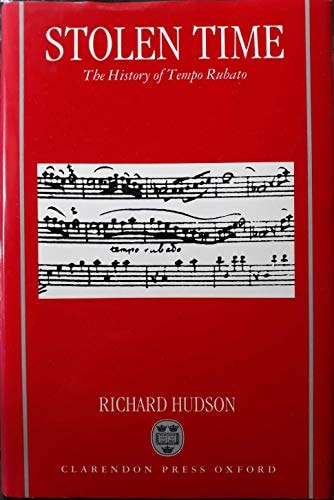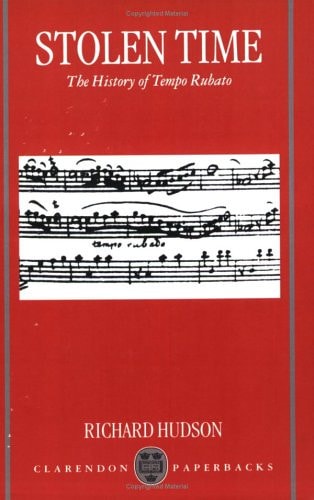
Stolen Time: The History of Tempo Rubato
0
0
As an Amazon Associate and affiliate partner, Menrva Books earns from qualifying purchases. Learn more
Author Description
Tracing the complex history of tempo rubato, this book identifies and traces the development of two main types of rubato: an earlier one in which note values in a melody are altered while the accompaniment keeps strict time, and a later, more familiar one in which the tempo of the entire musical substance fluctuates. In the course of his narrative, Hudson ranges widely over western music, from Gregorian Chant to Chopin, from C.P.E. Bach to jazz, quoting extensively from the writings of theorists, composers, and performers. In so doing he not only suggests new ways of approaching the rubato in the music of nineteenth-century composers like Chopin and Liszt, where we expect to encounter the term, but also illuminates the music of earlier and later periods, revealing its use even in the music of that most metronomic of composers, Stravinsky.
Menrva's Summary
THE THESIS
This book investigates the historical evolution and technical classification of tempo rubato, a fundamental yet elusive concept in Western musical performance. Richard Hudson, a respected musicologist, utilizes a vast array of primary source documents, including treatises from theorists and personal writings from composers, to categorize rubato into two distinct historical types. By examining the shift from melodic alteration over a steady beat to the modern practice of fluctuating the entire musical tempo, Hudson provides a rigorous framework for understanding rhythmic expression across centuries of composition.
THE SCOPE MAP
What You Will Find
- A detailed taxonomy of two primary types of tempo rubato: melodic alteration versus global tempo fluctuation.
- A chronological survey of Western music spanning from Gregorian Chant to the twentieth-century works of Stravinsky.
- Extensive analysis of primary source material from composers and theorists such as C.P.E. Bach, Chopin, and Liszt.
- Practical implications for performance practice in nineteenth-century piano repertoire and beyond.
THE AUTHORITY PERSPECTIVE
Experts and musicologists frequently cite this work as the definitive scholarly resource on the history of rubato. Readers often note the academic density of the prose, which requires a strong background in music theory to fully appreciate the technical arguments presented.
Page Count:
496
Publication Date:
1997-04-17
Publisher:
Clarendon Press
ISBN-10:
0198166672
ISBN-13:
9780198166672
Non-Fiction
Music
Criticism history
Tempo Music
Music History
Music theory