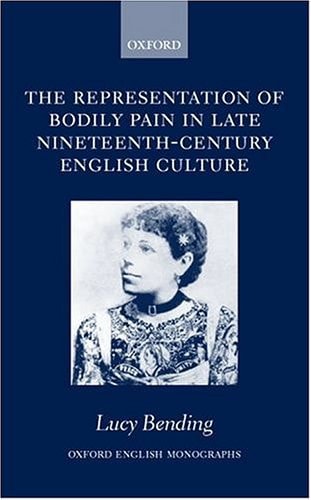
The Representation of Bodily Pain in Late Nineteenth-Century English Culture
0
0
As an Amazon Associate and affiliate partner, Menrva Books earns from qualifying purchases. Learn more
Author Description
This book presents a study of the ways in which concepts of pain were treated across a broad range of late Victorian writing, placing literary texts alongside sermons, medical textbooks and the campaigning leaflets. Pain is not a shared, cross-cultural phenomenon and this book uses the examples of fire-walking, flogging, and tattooing to show that, despite the fact that pain is often invoked as a marker of shared human identity, understandings of pain are sharply affected by class, gender, race, and supposed degree of criminality. In arguing this case, Virginia Woolf's claim that there is no language for pain is taken seriously, but the importance of this book lies in its exploration of the ways in which the seemingly incommunicable experience of bodily suffering can be conveyed.
Menrva's Summary
THE THESIS
This book investigates how late nineteenth-century English culture constructed and communicated the experience of bodily pain across diverse literary and social texts. Lucy Bending, a scholar of Victorian literature, examines how pain functions not as a universal constant, but as a socially mediated concept shaped by power dynamics. By analyzing a wide array of sources—from medical literature to political pamphlets—the author argues that pain is fundamentally interpreted through the lenses of class, gender, race, and criminality.
THE SCOPE MAP
What You Will Find
- Analysis of late Victorian literary texts alongside sermons and medical textbooks
- Examination of specific cultural phenomena including fire-walking, flogging, and tattooing
- Investigation into the intersection of pain with social hierarchies like class and gender
- Exploration of the linguistic challenges inherent in describing physical suffering
THE AUTHORITY PERSPECTIVE
Scholars in the field of Victorian studies and medical humanities frequently cite this work for its rigorous interdisciplinary approach to the history of the body. Readers note the academic density of the prose, which serves as a foundational text for understanding how nineteenth-century discourse framed the limits of human empathy.
Page Count:
320
Publication Date:
2000-11-09
Publisher:
Clarendon Press
ISBN-10:
0198187173
ISBN-13:
9780198187172
History
Literary Criticism
Pain
Community Tags
Similar Books