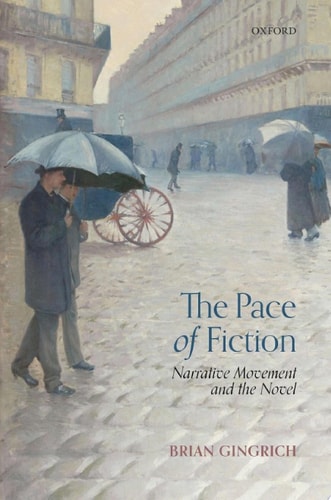
The Pace of Fiction: Narrative Movement and the Novel
0
0
As an Amazon Associate and affiliate partner, Menrva Books earns from qualifying purchases. Learn more
Author Description
The Pace of Fiction redefines the literary history of the novel by analyzing its most elaborate feature: its pace. It moves from the rise of the novel to realism and modernism. It starts by tracing the evolution of two narrative units: scenes ("shown" slowly) and summaries ("told" swiftly). These units emerge from the conflict of epic and drama, gain shape in the commentaries of Fielding and Goethe, and become dynamically opposed in nineteenth-century realism. In Middlemarch, they rotate in regular sequence: summaries move swiftly until scenes slow them down; scenes play out dramatically until summaries sweep them forward; their movement imitates the conflict of fate and free will. Over the course of the nineteenth century, however, scenic impulses overtake summary storytelling. The reader sees the tendency already in Austen's dialogues, Hawthorne's tableaux, or Balzac's battering drama, and finds it in Jane Eyre's placement of summaries in private scenes. When Flaubert extends scenic vividness to all of his summaries, and when Henry James subordinates his summaries to scenic consciousness, the extreme pressure of scene upon summary brings the opposition of realist pacing to collapse. But other oppositions arise in the modernisms that follow. In the alternation of stasis and kinesis, of drifting thoughts and everyday actions, of stories and acts of storytelling--in Proust, Joyce, Woolf, Mann, Hemingway--pace gathers and creates meaning in new ways.
Menrva's Summary
THE THESIS
This work investigates how the evolution of narrative pacing—specifically the interplay between scene and summary—has fundamentally shaped the history and structural development of the novel. Brian Gingrich, a scholar of literary history, utilizes a formalist approach to trace the technical mechanics of storytelling from the eighteenth century through the modernist era. By examining how authors manipulate the speed of narrative delivery, he argues that pacing is not merely a stylistic choice but a core component of how novels construct meaning and simulate human experience.
THE SCOPE MAP
What You Will Find
- A historical analysis of the transition from epic and dramatic roots to realist and modernist structures.
- A technical framework defining the functional differences between 'shown' scenes and 'told' summaries.
- Detailed case studies of authors including Fielding, Goethe, Austen, Balzac, Flaubert, James, Proust, Joyce, and Woolf.
Scope Limits
- The study focuses primarily on the Western canon of the novel and does not address non-Western narrative traditions.
- It excludes contemporary digital or experimental narrative forms that fall outside the traditional novelistic framework.
THE AUTHORITY PERSPECTIVE
Scholars and critics recognize this text as a rigorous contribution to narratology that provides a fresh lens for understanding the mechanics of prose fiction. Readers frequently note the academic density of the prose, which is best suited for students and researchers interested in the formal evolution of the novel.
Page Count:
224
Publication Date:
2021-01-01
Publisher:
OUP Oxford
ISBN-10:
0191899143
ISBN-13:
9780191899140
History
Narratology
History of the Novel
Literary theory
Literary Criticism
Indigenous
19th Century
Academic
Community Tags
Similar Books