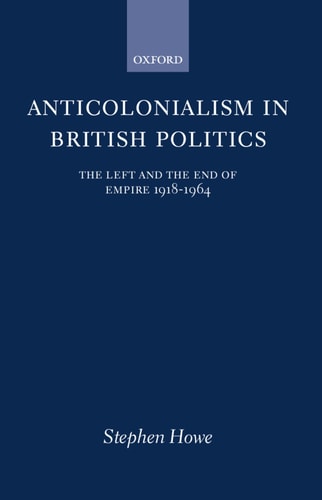
Anticolonialism in British Politics: The Left and the End of Empire 1918-1964
0
0
As an Amazon Associate and affiliate partner, Menrva Books earns from qualifying purchases. Learn more
Author Description
This is the first scholarly study of British anticolonialism, which was an offshoot of a massive global upsurge of anticolonial sentiment which has dominated much of the history of this century. In this wide-ranging and important book, Stephen Howe evaluates the changing ways in which, arising out of the experience of Empire and decolonization, more general ideas about imperialism, nationalism, and underdevelopment were developed during these years. He also surveys the attitudes and activities relating to colonial issues of British critics of Empire during the years of decolonization. The book has considerable contemporary relevance because the Falklands and Gulf Wars, race relations, and South African apartheid cannot fully be understood except in the context of the experience of decolonization and the legacy of Empire.
Menrva's Summary
THE THESIS
This work investigates the evolution of anticolonial sentiment within British political discourse and its influence on the dismantling of the British Empire between 1918 and 1964. Stephen Howe, a scholar of imperial history, utilizes extensive archival research and political analysis to map how the British Left conceptualized imperialism, nationalism, and global underdevelopment. The book argues that these intellectual shifts were not merely reactive but were foundational to the broader political landscape of the twentieth century.
THE SCOPE MAP
What You Will Find
- Analysis of British political attitudes toward colonial administration and decolonization from 1918 to 1964.
- Examination of the intellectual development of concepts regarding imperialism and global inequality.
- Evaluation of the activities and rhetoric of prominent British critics of the Empire.
- Contextualization of post-imperial conflicts and race relations within the legacy of decolonization.
THE AUTHORITY PERSPECTIVE
Historians and political scientists frequently cite this monograph as a foundational text for understanding the internal British opposition to imperial expansion. Readers often note the academic density of the prose, which provides a rigorous examination of the ideological shifts within the British Left during the mid-twentieth century.
Page Count:
392
Publication Date:
1993-12-16
Publisher:
Oxford University Press
ISBN-10:
019820423X
ISBN-13:
9780198204237
Politics
History
British History
Public opinion
Colonialism
Decolonization
Imperialism
Great Britain
Community Tags
Similar Books