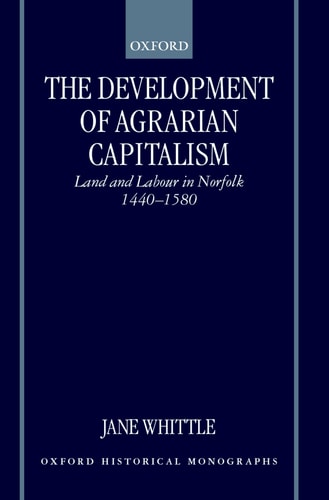
The Development of Agrarian Capitalism: Land and Labour in Norfolk 1440-1580
0
0
As an Amazon Associate and affiliate partner, Menrva Books earns from qualifying purchases. Learn more
Author Description
This is an important new study of the roots of capitalism. Jane Whittle provides a penetrating analysis of the links between peasant society and early capitalism as she discusses north-east Norfolk, a county which played a leading role in the agrarian revolution. She uses a rich variety of sources from the precocious and commercialized locality to examine a range of topics, from the manorial system and serfdom, land rights, land markets and inheritance, to the distribution of land and wealth, the development of labor pools, and changing labor laws.
Menrva's Summary
THE THESIS
This study investigates the origins of agrarian capitalism by examining the transformation of land and labor structures in Norfolk between 1440 and 1580. Jane Whittle, a specialist in late medieval and early modern social history, utilizes extensive archival records from the Norfolk region to challenge traditional narratives regarding the transition from feudalism to market-oriented farming. Her research argues that the commercialization of the countryside was a gradual process driven by specific shifts in land tenure, inheritance practices, and the regulation of labor pools.
THE SCOPE MAP
What You Will Find
- Analysis of the manorial system and the decline of serfdom in north-east Norfolk.
- Examination of land markets, inheritance customs, and property rights.
- Evaluation of labor laws and the formation of rural wage-labor markets.
- Synthesis of wealth distribution patterns and social stratification in early modern England.
THE AUTHORITY PERSPECTIVE
Historians and economic scholars frequently cite this work as a rigorous, evidence-based contribution to the study of early modern agrarian transitions. Readers often note the academic density of the prose, which provides a detailed, localized perspective on broader economic theories.
Page Count:
376
Publication Date:
2000-07-13
Publisher:
Clarendon Press
ISBN-10:
0198208421
ISBN-13:
9780198208426
Economics
History
Capitalism
Farm Tenancy
Agriculture
Great Britain
Social History
Community Tags
Similar Books