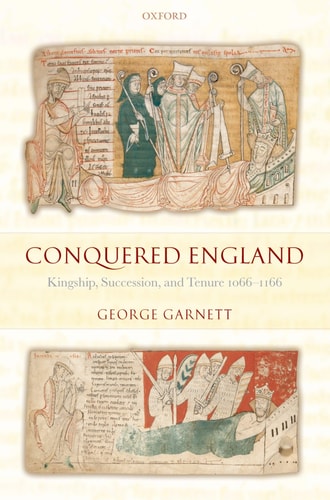
Conquered England: Kingship, Succession, and Tenure 1066-1166
0
0
As an Amazon Associate and affiliate partner, Menrva Books earns from qualifying purchases. Learn more
Author Description
Conquered England argues that Duke William of Normandy's claim to succeed Edward the Confessor on the throne of England profoundly influenced not only the practice of royal succession, but also played a large part in creating a novel structure of land tenure, dependent on the king. In these two fundamental respects, the attempt made in the aftermath of the Conquest to demonstrate seamless continuity with Anglo-Saxon England severed almost all continuity. A paradoxical result was a society in which instability in succession at the top exacerbated instability lower down. The first serious attempt to address these problems began when arrangements were made, in 1153, for the succession to King Stephen. Henry II duly succeeded him, but claimed rather to have succeeded his grandfather, Henry I, Stephen's predecessor. Henry II's attempts to demonstrate continuity with his grandfather were modelled on William the Conqueror's treatment of Edward the Confessor. Just as William's fabricated history had been the foundation for the tenurial settlement recorded in the Domesday Book, so Henry II's, in a different way, underpinned the early common law procedures which began to undermine aspects of that settlement. The official history of the Conquest played a crucial role not only in creating a new society, but in the development of that society.
Menrva's Summary
THE THESIS
This book investigates how the Norman Conquest fundamentally altered the structures of English kingship, succession, and land tenure between 1066 and 1166. George Garnett, a scholar of medieval history, examines the paradox of how the Norman attempt to claim seamless continuity with the Anglo-Saxon past actually resulted in a radical rupture of existing social and legal norms. By analyzing royal claims and administrative records, the author argues that the fabricated history of the Conquest served as the primary mechanism for establishing a new, king-dependent system of land tenure that defined the century.
THE SCOPE MAP
What You Will Find
- Analysis of the transition from Anglo-Saxon to Norman royal succession practices.
- Examination of the Domesday Book as a tool for enforcing new tenurial settlements.
- Investigation into the legal and political maneuvers of Henry II and his predecessors.
- Evaluation of how official historical narratives shaped the development of early common law.
THE AUTHORITY PERSPECTIVE
Historians and medievalists recognize this work as a rigorous, highly detailed examination of the legal and political mechanics of the Norman period. Readers frequently note the academic density of the prose, which is intended for those with a strong background in medieval institutional history.
Page Count:
420
Publication Date:
2007-03-29
Publisher:
Oxford University Press
ISBN-10:
019820793X
ISBN-13:
9780198207931
History
Great Britain
Legal History
Political History
Monarchy
British History
Community Tags
Similar Books