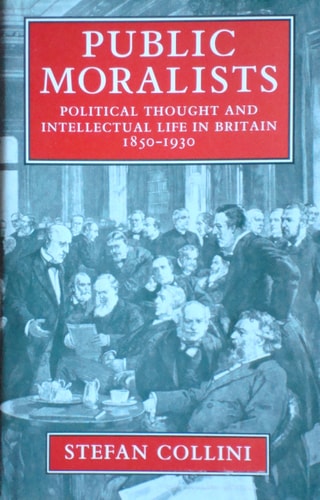
Public Moralists: Political Thought and Intellectual Life in Britain, 1850-1930
0
0
As an Amazon Associate and affiliate partner, Menrva Books earns from qualifying purchases. Learn more
Author Description
This imaginative and unusual book explores the moral sensibilities and cultural assumptions that were at the heart of political debate in Victorian and early twentieth-century Britain. It focuses on the role of intellectuals as public moralists and suggests ways in which their more formal political theory rested upon habits of response and evaluation that were deeply embedded in wider social attitudes and aesthetic judgments. Collini examines the characteristic idioms and strategies of argument employed in periodical and polemical writing, and reconstructs the sense of identity and of relation to an audience exhibited by social critics from John Stuart Mill and Matthew Arnold to J.M. Keynes and F.R. Leavis.
Menrva's Summary
THE THESIS
This work investigates how the moral sensibilities and cultural assumptions of intellectuals shaped the landscape of British political discourse between 1850 and 1930. Stefan Collini, a noted historian of ideas, examines the intersection of formal political theory and the informal habits of evaluation prevalent in Victorian and early twentieth-century society. By analyzing the rhetorical strategies of prominent social critics, the author argues that political thought cannot be divorced from the broader aesthetic and social attitudes of the era.
THE SCOPE MAP
What You Will Find
- Analysis of the role of the intellectual as a public moralist in British society.
- Examination of the rhetorical idioms and argumentative strategies used in periodical and polemical writing.
- Case studies of influential figures including John Stuart Mill, Matthew Arnold, J.M. Keynes, and F.R. Leavis.
- Exploration of the relationship between social critics and their contemporary audiences.
THE AUTHORITY PERSPECTIVE
Scholars frequently cite this text as a foundational study for understanding the cultural context of British political thought. Experts highlight the author's ability to bridge the gap between formal political theory and the social attitudes that informed it.
Page Count:
392
Publication Date:
1991-11-28
Publisher:
Oxford University Press
ISBN-10:
0198201737
ISBN-13:
9780198201731
Philosophy
History
British History
Intellectual History
Great Britain
Community Tags
Similar Books