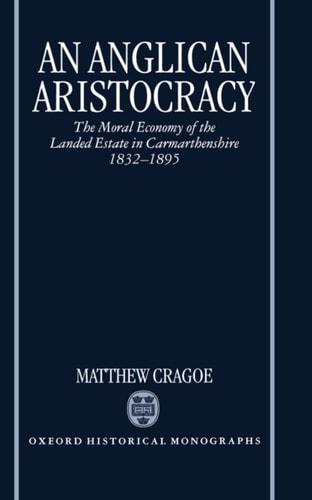
An Anglican Aristocracy: The Moral Economy of the Landed Estate in Carmarthenshire 1832-1895
0
0
As an Amazon Associate and affiliate partner, Menrva Books earns from qualifying purchases. Learn more
Author Description
This account of nineteenth-century Carmarthenshire emphasizes the social and political dominance of the Anglican and landowning nobility and gentry for much of the period. Matthew Cragoe explores the nature and public roles of a governing élite, arguing that their influence was not simply a function of their members' wealth or their control of local government and the administration of the law, but had a vital ideological dimension in the aristocracy's paternalistic ethic, which found powerful and practical expression in the 'moral economy' of the landed estate.
Menrva's Summary
THE THESIS
This work investigates how the Anglican landed elite in nineteenth-century Carmarthenshire maintained social and political hegemony through a specific ideological framework known as the moral economy. Matthew Cragoe, a historian specializing in nineteenth-century British social and political structures, utilizes local archives and estate records to analyze the governing class. He argues that the influence of the gentry extended beyond mere wealth or legal control, rooting itself in a paternalistic ethic that defined the relationship between landowners and the local population. By examining the practical application of this moral economy, the author provides a detailed study of how power was legitimized and exercised during a period of significant social transition.
THE SCOPE MAP
What You Will Find
- An analysis of the social and political dominance of the Anglican landowning class in Carmarthenshire between 1832 and 1895.
- A detailed examination of the paternalistic ideology that governed the management of landed estates.
- Primary source research derived from local government records, estate papers, and contemporary political correspondence.
- A study of the interplay between religious affiliation, land ownership, and local administrative authority.
THE AUTHORITY PERSPECTIVE
Historians and scholars of Welsh history recognize this monograph as a rigorous examination of nineteenth-century power structures. Readers frequently note the academic density of the prose, which serves as a foundational text for understanding the intersection of land ownership and social control in rural Britain.
Page Count:
296
Publication Date:
1996-05-23
Publisher:
Clarendon Press
ISBN-10:
0198205945
ISBN-13:
9780198205944
History
British History
Political History
Social History
Wales history
Social Class
Wales
Sociology
Community Tags
Similar Books