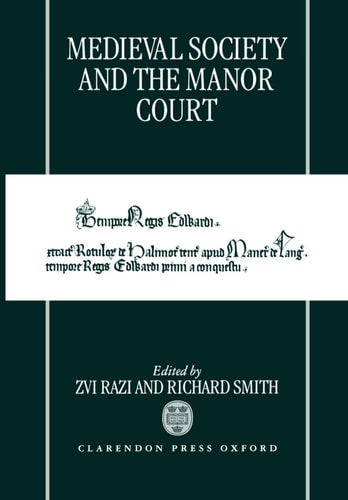
Medieval Society and the Manor Court
0
0
As an Amazon Associate and affiliate partner, Menrva Books earns from qualifying purchases. Learn more
Author Description
The records of manorial courts have been used increasingly as the principal source for the reconstruction of rural and small town society in Medieval England. They offer a unique source with which to investigate peasant demography, family patterns, the village community and economy, the characteristics and instruments of customary law and the ways in which that law was perceived and exploited by landlords and tenants.
Menrva's Summary
THE THESIS
This work investigates how manorial court records serve as the primary evidence for reconstructing the social, economic, and legal structures of rural Medieval England. The authors, Richard M. Smith and Zvi Razi, utilize extensive archival data to analyze the interactions between landlords and tenants within the framework of customary law. By examining these records, the text argues that the manor court was not merely a judicial body but a central institution for managing peasant demography and village community dynamics. The study provides a rigorous methodology for interpreting these historical documents to reveal the complexities of medieval life.
THE SCOPE MAP
What You Will Find
- Analysis of peasant demography and family patterns in medieval villages.
- Examination of the instruments and applications of customary law.
- Investigation into the economic relationships between landlords and tenants.
- Methodological approaches to using manorial court records as primary source material.
THE AUTHORITY PERSPECTIVE
Historians and scholars of the Middle Ages frequently cite this text as a foundational resource for understanding the granular details of rural English society. Readers often note the academic density of the prose, which is tailored for researchers and students of medieval legal and social history.
Page Count:
728
Publication Date:
1996-10-31
Publisher:
Clarendon Press
ISBN-10:
0198201907
ISBN-13:
9780198201908
History
Economics
Manors
Law Medieval
Great Britain
Social History
Legal History
Community Life
Community Tags
Similar Books