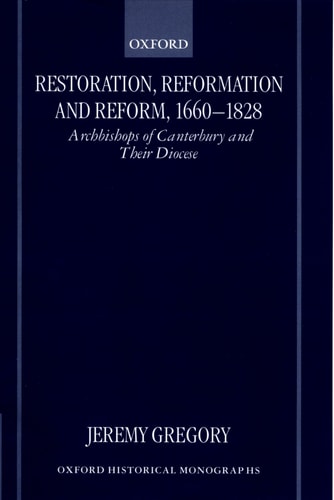
Restoration, Reformation and Reform, 1660-1828: Archbishops of Canterbury and Their Diocese
0
0
As an Amazon Associate and affiliate partner, Menrva Books earns from qualifying purchases. Learn more
Author Description
This wide-ranging and original book makes a significant contribution to our understanding of the Church of England in the period between 1660 and 1828. It explores the nature of the Restoration ecclesiastical regime, the character of the clerical profession, and the quality of the clergy's pastoral work, and the question of Church reform through a detailed study of the diocese of the archbishops of Canterbury. The book covers the political, economic, cultural, intellectual, and pastoral functions of the established Church and highlights the links to the Church of both earlier and later eras. The author argues that contrary to the common criticisms the Church of this period was an effective institution, with its own coherent and positive rationale.
Menrva's Summary
THE THESIS
This work investigates the efficacy and institutional rationale of the Church of England between 1660 and 1828 by examining the specific administrative and pastoral practices within the diocese of the Archbishops of Canterbury. Jeremy Gregory, a scholar of ecclesiastical history, utilizes extensive archival research to challenge traditional historiographical critiques that characterize this period as one of clerical decline. By analyzing the political, economic, and cultural functions of the Church, the author constructs a framework that presents the institution as a coherent and active force in English society during the long eighteenth century.
THE SCOPE MAP
What You Will Find
- Analysis of the Restoration ecclesiastical regime and its administrative evolution.
- Examination of the clerical profession, including pastoral duties and professional standards.
- Investigation into the political, economic, and intellectual roles of the Church of England.
- Comparative study of the diocese of Canterbury as a microcosm of national church reform.
THE AUTHORITY PERSPECTIVE
Historians and scholars of the period recognize this monograph as a foundational text for understanding the internal mechanics of the Church of England. Readers frequently note the academic density of the prose and the rigorous use of primary source material to support the author's revisionist arguments.
Page Count:
374
Publication Date:
2000-05-25
Publisher:
Clarendon Press
ISBN-10:
0198208308
ISBN-13:
9780198208303
History
Religious History
Ecclesiastical History
Church History
British History
Great Britain
Community Tags
Similar Books