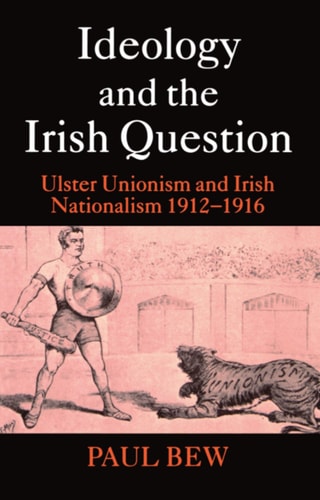
Ideology and the Irish Question: Ulster Unionism and Irish Nationalism 1912-1916
0
0
As an Amazon Associate and affiliate partner, Menrva Books earns from qualifying purchases. Learn more
Author Description
Going right to the heart of the Irish Question, Paul Bew offers a re-interpretation of Irish politics in the critical 1912-1916 period. Bew offers a full treatment of the debate concerning land, economy, religion, language, and national identity in the period, and ends with a discussion of the Easter Rising of 1916 which destroyed Redmond's party. The political, cultural, and economic implications of this development are drawn out, and Bew examines their continuing effect on Irish history.
Menrva's Summary
THE THESIS
This work investigates the ideological foundations and political tensions that defined the Irish Question between 1912 and 1916. Paul Bew, a noted historian of Irish politics, utilizes a rigorous analytical framework to re-examine the competing interests of Ulster Unionism and Irish Nationalism. By synthesizing economic, religious, and cultural data, the author argues that the collapse of Redmond's party and the subsequent Easter Rising were the culmination of long-standing structural conflicts rather than isolated events.
THE SCOPE MAP
What You Will Find
- Analysis of the socio-economic debates surrounding land reform and industrial development in Ireland.
- Examination of the role of religion and language in shaping national identity during the early twentieth century.
- Evaluation of the political decline of the Irish Parliamentary Party under John Redmond.
- Assessment of the long-term historical implications of the 1916 Easter Rising on modern Irish statehood.
THE AUTHORITY PERSPECTIVE
Historians frequently cite this text as a foundational study for understanding the ideological complexities of the pre-partition era. Scholars often highlight the author's balanced approach to the conflicting narratives of Unionism and Nationalism as a standard for academic inquiry in the field.
Page Count:
192
Publication Date:
1998-06-04
Publisher:
Clarendon Press
ISBN-10:
0198207085
ISBN-13:
9780198207085
History
Nationalism
Twentieth Century
Ireland
Irish Question
Irish History
Community Tags
Similar Books