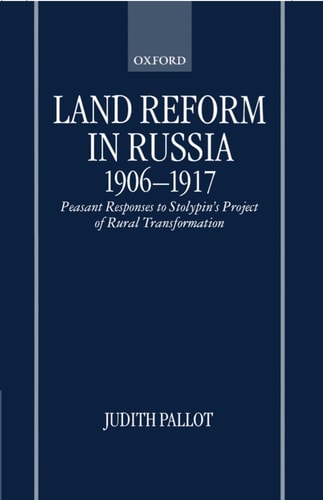
Land Reform in Russia, 1906-1917: Peasant Responses to Stolypin's Project of Rural Transformation
0
0
As an Amazon Associate and affiliate partner, Menrva Books earns from qualifying purchases. Learn more
Author Description
Since the collapse of the USSR there has been a growing interest in the Stolypin Land Reform as a possible model for post-Communist agrarian development. Using recent theoretical and empirical advances in Anglo-American research, Dr Pallot examines how peasants throughout Russia received, interpreted, and acted upon the government's attempts to persuade them to quit the commune and set up independent farms.
Menrva's Summary
THE THESIS
This book investigates how the Russian peasantry responded to the Stolypin land reforms between 1906 and 1917 and whether these reforms serve as a viable model for post-Communist agrarian development. Dr. Judith Pallot, an expert in Russian geography and agrarian history, utilizes a combination of archival data and contemporary theoretical frameworks to analyze the implementation of these reforms. She argues that the success of the government's project was fundamentally constrained by the complex social and economic realities of the rural commune system.
THE SCOPE MAP
What You Will Find
- Analysis of the Stolypin land reform legislation and its intended goals for rural transformation.
- Empirical data regarding peasant participation and resistance to the privatization of communal land.
- Examination of the socio-economic structure of the Russian village commune during the early 20th century.
- Comparative perspectives on the relevance of Stolypin's policies for modern agrarian reform in post-Soviet states.
THE AUTHORITY PERSPECTIVE
Scholars recognize this work as a rigorous examination of the intersection between state policy and local peasant agency in late Imperial Russia. The text is noted for its academic depth and is frequently cited by historians and political scientists studying the complexities of agrarian transition.
Page Count:
272
Publication Date:
1999-07-29
Publisher:
Clarendon Press
ISBN-10:
0198206569
ISBN-13:
9780198206569
History
Economics
Land tenure
Russian History