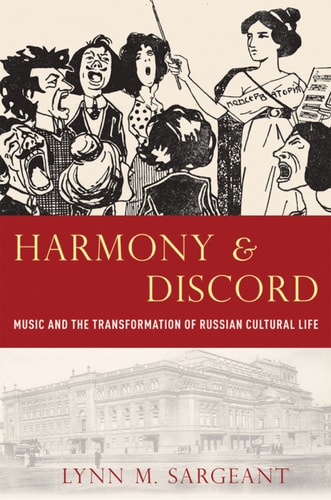
Harmony and Discord: Music and the Transformation of Russian Cultural Life
0
0
As an Amazon Associate and affiliate partner, Menrva Books earns from qualifying purchases. Learn more
Author Description
Harmony and Discord: Music and the Transformation of Russian Cultural Life explores the complex development of Russian musical life during the nineteenth and early twentieth centuries. At the heart of this cultural history lies the Russian Musical Society, as both a unique driving force behind the institutionalization of music and a representative of the growing importance of voluntary associations in public life. Sustained simultaneously by private initiative and cooperative relationships with the state, the Russian Musical Society played a key role in the creation of Russia's infrastructure for music and music education. Author Lynn M. Sargeant explores the fluid nature of Russian social identity through the broad scope of musical life, including not only the "leading lights" of the era but also rank-and-file musicians, teachers, and students. Although Russian musicians longed for a secure place within the new hierarchy of professions, their social status remained ambiguous throughout the nineteenth century. Traditional reliance on serf musicians and foreigners left lasting scars that motivated musicians' efforts to obtain legal rights and social respectability. And women's increasing visibility in the musical world provoked acrimonious debates that were, at heart, efforts by male musicians to strengthen their claims to professional status by denying the legitimacy of female participation. Sargeant demonstrates that the successful development of a Russian musical infrastructure salved persistent anxieties about Russia's place vis-à-vis its European cultural competitors. Remarkably, the institutions developed by the Russian Musical Society survived the upheavals of war and revolution to become the foundation for the Soviet musical system.A wealth of historical documentation makes Harmony and Discord required reading for musicologists, sociologists and historians interested in this period, and the abundance of amusing anecdotes and the author's lucid and lively lite
Menrva's Summary
THE THESIS
How did the institutionalization of music through the Russian Musical Society shape the professional identity and social standing of musicians in nineteenth and early twentieth-century Russia? Lynn M. Sargeant, a scholar of Russian history, utilizes archival records and institutional documentation to analyze the intersection of music, state policy, and social hierarchy. The book argues that the development of a formal musical infrastructure was a strategic effort by Russian musicians to secure professional legitimacy and national prestige in response to European cultural competition.
THE SCOPE MAP
What You Will Find
- Analysis of the Russian Musical Society as a model for voluntary associations.
- Examination of the transition from serf-based musical labor to professionalized education.
- Discussion of gender dynamics and the resistance to female participation in the professional sphere.
- Historical context regarding the survival of these institutions through the Soviet transition.
Scope Limits
- The text focuses primarily on the institutional and social history of music rather than detailed musicological analysis of specific compositions.
- The study is geographically and culturally bounded by the Russian Empire and its immediate transition into the early Soviet period.
THE AUTHORITY PERSPECTIVE
Historians and musicologists recognize this work as a significant contribution to the study of Russian cultural development and professionalization. Readers frequently note the clarity of the prose and the author's ability to synthesize complex social history with institutional analysis.
Page Count:
368
Publication Date:
2011-01-01
Publisher:
Oxford University Press
ISBN-10:
0190453672
ISBN-13:
9780190453671
History
European History
Cultural History
Humanities
Music History
Russian History
Music Russian
Music
Sociology
Music Education
Community Tags
Similar Books