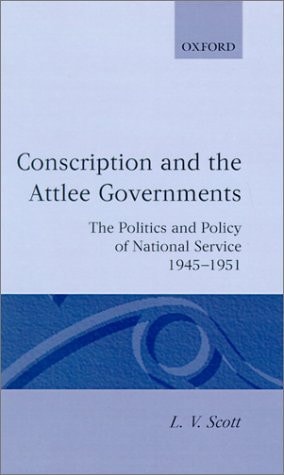
Conscription and the Attlee Governments: The Politics and Policy of National Service 1945-1951
0
0
As an Amazon Associate and affiliate partner, Menrva Books earns from qualifying purchases. Learn more
Author Description
In the years immediately following the Second World War, Britain peacetime conscription was practiced for the first time. L.V. Scott examines the military thinking regarding conscription, showing how the 1947 National Service Act came to be regarded by the military as deficient and expensive. The demands of conscription retarded the development of an efficient post-war regular army. Scott explores the policies of both Labour and Conservative parties, tracing the process by which Labour, previously bitterly opposed to conscription, came to pass the 1947 Act. His book is a valuable analysis of an important political question and of changing assumptions about British defense priorities in the pivotal post-war years.
Menrva's Summary
THE THESIS
This work investigates the political and military motivations behind the implementation of peacetime conscription in Britain during the Attlee administration. L. V. Scott, a scholar of British defense policy, utilizes primary government records and military archives to analyze the transition from wartime mobilization to a permanent conscription framework. The text argues that the 1947 National Service Act was a compromise born of shifting geopolitical pressures rather than a coherent long-term defense strategy. Scott demonstrates how the financial and logistical burdens of this policy ultimately hindered the modernization of the British regular army.
THE SCOPE MAP
What You Will Find
- Analysis of the 1947 National Service Act and its legislative history.
- Examination of the ideological shift within the Labour Party regarding compulsory military service.
- Comparative study of Labour and Conservative defense priorities in the immediate post-war era.
- Assessment of the impact of conscription on military efficiency and post-war economic recovery.
THE AUTHORITY PERSPECTIVE
Historians and political scientists recognize this monograph as a definitive account of the internal debates that shaped British defense policy between 1945 and 1951. The text is noted for its rigorous use of archival evidence and its clear-eyed assessment of the tensions between political necessity and military readiness.
Page Count:
320
Publication Date:
1993-12-02
Publisher:
Clarendon Press
ISBN-10:
0198204213
ISBN-13:
9780198204213
History
British History
Military History
Community Tags
Similar Books