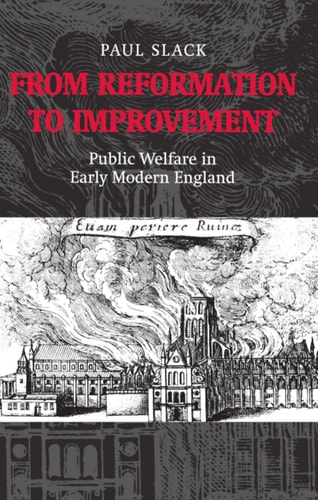
From Reformation to Improvement: Public Welfare in Early Modern England
0
0
As an Amazon Associate and affiliate partner, Menrva Books earns from qualifying purchases. Learn more
Author Description
Paul Slack's incisive analysis shows how the English came to believe between 1500 and 1740 that piecemeal improvement was more likely to be achieved than total social reformation. He examines social policy and institutions such as workhouses and hospitals in order to illustrate how contemporaries tried to shape their social and moral environment, and how they defined the notion of `welfare'.
Menrva's Summary
THE THESIS
This work investigates the fundamental shift in English social thought between 1500 and 1740, specifically the transition from a desire for total social reformation to a pragmatic focus on incremental improvement. Paul Slack, a distinguished historian of early modern England, utilizes a wide array of administrative records and contemporary literature to trace this evolution. He argues that this period saw the emergence of a distinct concept of 'welfare' that prioritized localized, manageable interventions over utopian societal restructuring. By analyzing the development of institutional responses to poverty and social disorder, Slack provides a framework for understanding how early modern English society conceptualized its moral and material obligations.
THE SCOPE MAP
What You Will Find
- Analysis of social policy development between 1500 and 1740.
- Examination of institutional structures including workhouses and hospitals.
- Evaluation of the shifting rhetoric regarding social reform and moral improvement.
- Historical context on the evolution of the term and practice of public welfare.
THE AUTHORITY PERSPECTIVE
Historians frequently cite this text as a foundational study for understanding the administrative and intellectual history of English social policy. Experts note that the prose is dense and scholarly, making it a primary resource for researchers focusing on the institutional history of the early modern period.
Page Count:
192
Publication Date:
1999-10-07
Publisher:
Clarendon Press
ISBN-10:
0198206615
ISBN-13:
9780198206613
History
Sociology
Public welfare
Social History
Public Policy
Great Britain
Workhouses
Almshouses
Community Tags
Similar Books