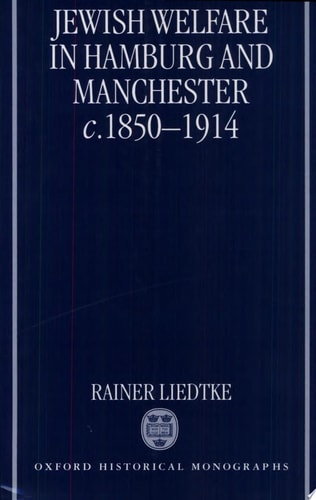
Jewish Welfare in Hamburg and Manchester, c. 1850-1914
0
0
As an Amazon Associate and affiliate partner, Menrva Books earns from qualifying purchases. Learn more
Author Description
The analysis of this important sphere of everyday life highlights the relevance of comparative history for an understanding of Jewish integration and identity formation in nineteenth-century Europe.
Menrva's Summary
THE THESIS
This work investigates how Jewish welfare institutions in Hamburg and Manchester functioned as critical sites for identity formation and social integration between 1850 and 1914. Rainer Liedtke, a scholar of modern European history, utilizes a comparative framework to examine the organizational structures of charity and social aid within these two distinct urban environments. By analyzing the administrative and social practices of these organizations, the author argues that welfare was not merely a response to poverty but a mechanism for defining communal boundaries and negotiating the status of Jewish populations within the broader European context.
THE SCOPE MAP
What You Will Find
- Comparative analysis of Jewish communal welfare structures in Germany and England.
- Examination of the transition from traditional religious charity to modern social work practices.
- Evaluation of how welfare institutions facilitated the integration of Jewish migrants into urban society.
- Use of archival records, institutional reports, and local demographic data from the mid-nineteenth century to the outbreak of World War I.
THE AUTHORITY PERSPECTIVE
Historians recognize this monograph as a rigorous contribution to the study of Jewish social history and urban development in the nineteenth century. Scholars frequently cite the text for its methodological precision in applying comparative history to the study of minority integration.
Page Count:
280
Publication Date:
1998-11-12
Publisher:
Clarendon Press
ISBN-10:
0198207239
ISBN-13:
9780198207238
History
Great Britain
European History
Jewish Studies
Comparative History
Social History
Jews germany
Community Tags
Similar Books