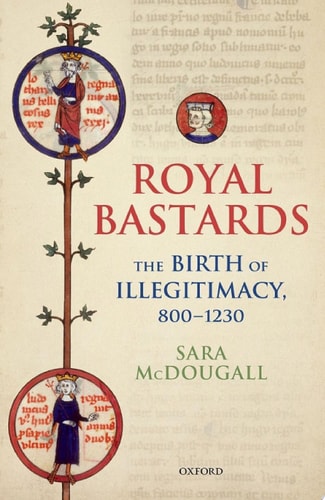
Royal Bastards: The Birth of Illegitimacy, 800-1230
0
0
As an Amazon Associate and affiliate partner, Menrva Books earns from qualifying purchases. Learn more
Author Description
The stigmatization as 'bastards' of children born outside of wedlock is commonly thought to have emerged early in Medieval European history. Christian ideas about legitimate marriage, it is assumed, set the standard for legitimate birth. Children born to anything other than marriage had fewer rights or opportunities. They certainly could not become king or queen. As this volume demonstrates, however, well into the late twelfth century, ideas of what made a child a legitimate heir had little to do with the validity of his or her parents' union according to the dictates of Christian marriage law. Instead a child's prospects depended upon the social status, and above all the lineage, of both parents. To inherit a royal or noble title, being born to the right father mattered immensely, but also being born to the right kind of mother. Such parents could provide the most promising futures for their children, even if doubt was cast on the validity of the parents' marriage. Only in the late twelfth century did children born to illegal marriages begin to suffer the same disadvantages as the children born to parents of mixed social status. Even once this change took place we cannot point to 'the Church' as instigator. Instead, exclusion of illegitimate children from inheritance and succession was the work of individual litigants who made strategic use of Christian marriage law. This new history of illegitimacy rethinks many long-held notions of medieval social, political, and legal history.
Menrva's Summary
THE THESIS
This book investigates the historical evolution of illegitimacy in medieval Europe, challenging the assumption that Christian marriage law was the primary driver of social exclusion for children born out of wedlock. Sara McDougall, a scholar of medieval legal and social history, utilizes an extensive analysis of royal and noble succession records from 800 to 1230. She argues that for much of this period, inheritance was determined by lineage and parental status rather than the canonical validity of a marriage. The text demonstrates that the shift toward excluding illegitimate children was a strategic, gradual process initiated by individual litigants rather than a top-down mandate from the Church.
THE SCOPE MAP
What You Will Find
- Analysis of royal and noble inheritance patterns across Western Europe.
- Examination of the intersection between canon law and secular social practices.
- Case studies of specific succession disputes in the eleventh and twelfth centuries.
Scope Limits
- The study focuses primarily on the elite strata of society and does not provide an exhaustive account of illegitimacy among the peasantry or lower classes.
THE AUTHORITY PERSPECTIVE
Historians and legal scholars recognize this work as a significant revisionist study that complicates traditional narratives regarding the influence of the Church on medieval family law. Readers frequently note the academic rigor of the research and the clarity with which the author navigates complex legal and social transitions.
Page Count:
320
Publication Date:
2016-01-01
Publisher:
OUP Oxford
ISBN-10:
0191088854
ISBN-13:
9780191088858
History
Europe
Legal History
European History
Royal Studies
Social History
Social status
Community Tags
Similar Books