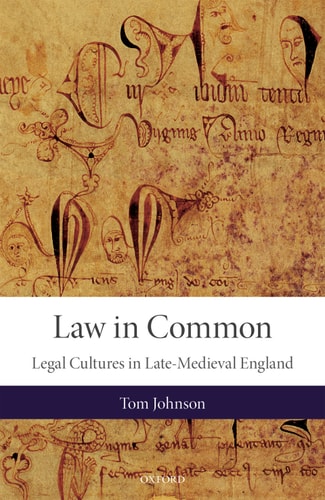
Law in Common: Legal Cultures in Late-Medieval England
0
0
As an Amazon Associate and affiliate partner, Menrva Books earns from qualifying purchases. Learn more
Author Description
There were tens of thousands of different local law-courts in late-medieval England, providing the most common forums for the working out of disputes and the making of decisions about local governance. While historians have long studied these institutions, there have been very few attempts to understand this complex institutional form of 'legal pluralism'. Law in Common provides a way of understanding this complexity by drawing out broader patterns of legal engagement. Tom Johnson first explores four 'local legal cultures'—in the countryside, in forests, in towns and cities, and in the maritime world—that grew up around legal institutions, landscapes, and forms of socio-economic practice in these places, and produced distinctive senses of law. Johnson then turns to examine 'common legalities', widespread forms of social practice that emerge across these different localities, through which people aimed to invoke the power of law. Through studies of the physical landscape, the production of legitimate knowledge, the emergence of English as a legal vernacular, and the proliferation of legal documents, the volume offers a new way to understand how common people engaged with law in the course of their everyday lives. Drawing on a huge body of archival research from the plenitude of different local institutions, Law in Common offers a new social history of law that aims to explain how common people negotiated the transformational changes of the long fifteenth century with, and through, legality.
Menrva's Summary
THE THESIS
This book investigates how the proliferation of local law courts in late-medieval England shaped the everyday legal engagement and social practices of common people. Tom Johnson, a historian specializing in medieval legal culture, utilizes a vast array of archival records from diverse local institutions to challenge traditional top-down views of legal history. He argues that legal pluralism was not merely a bureaucratic reality but a lived experience that allowed individuals to negotiate the significant socio-economic transformations of the fifteenth century.
THE SCOPE MAP
What You Will Find
- Analysis of four distinct local legal cultures: rural, forest, urban, and maritime.
- Examination of 'common legalities' or shared social practices across different jurisdictions.
- Investigation into the role of physical landscapes, the rise of English as a legal vernacular, and the proliferation of legal documentation.
Scope Limits
- The study focuses primarily on the long fifteenth century in England.
- It does not provide an exhaustive catalog of every individual local court but rather identifies broader patterns of engagement.
THE AUTHORITY PERSPECTIVE
Scholars in the field of medieval legal history recognize this work as a significant contribution to the study of legal pluralism and social history. Readers frequently note the academic density of the prose, which is balanced by the author's extensive use of primary archival research to ground his theoretical framework.
Page Count:
352
Publication Date:
2019-01-01
Publisher:
OUP Oxford
ISBN-10:
019108848X
ISBN-13:
9780191088483
History
England
Great Britain
Social History
Europe
European History
Legal History
Law history
Community Tags
Similar Books