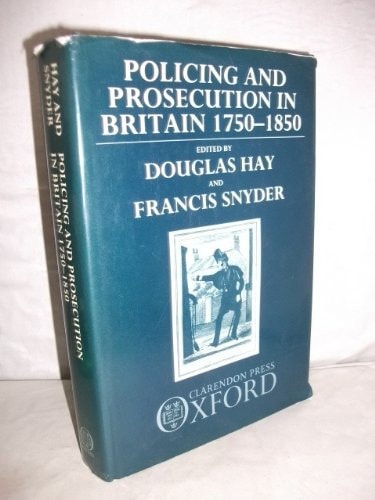
Policing and Prosecution in Britain 1750-1850
0
0
As an Amazon Associate and affiliate partner, Menrva Books earns from qualifying purchases. Learn more
Author Description
Until recently, English law was distinctive because it provided for the police, rather than public prosecutors, to prosecute the accused. The 1986 creation of the Crown Prosecution Service changed the old system which had evolved over two centuries. Here, Hay and Snyder show how that old system emerged, and explore its place in state power, class relations, and constitutional theory. They examine the origins of police prosecutorial power, its social significance and features, and its evolution in comparison with policing in Scotland and Ireland.
Menrva's Summary
THE THESIS
This work investigates the historical development and socio-political implications of the English system where police, rather than public prosecutors, held the authority to prosecute the accused between 1750 and 1850. Douglas Hay and Francis Snyder, both established scholars in legal history, utilize archival records and constitutional theory to analyze how this unique prosecutorial framework functioned within the broader context of state power and class relations. They argue that the evolution of these practices was deeply intertwined with the social structures of the era, providing a critical look at the transition toward the modern Crown Prosecution Service.
THE SCOPE MAP
What You Will Find
- Historical analysis of the English legal system from 1750 to 1850.
- Comparative study of policing and prosecution practices in Scotland and Ireland.
- Examination of the intersection between state power, class relations, and constitutional theory.
- Detailed origins of police-led prosecutorial authority and its eventual transformation.
THE AUTHORITY PERSPECTIVE
Legal historians and scholars of criminal justice frequently cite this text as a foundational resource for understanding the evolution of the British legal apparatus. Experts highlight the rigorous archival research and the clarity with which the authors connect historical legal procedures to broader societal shifts.
Page Count:
488
Publication Date:
1989-12-07
Publisher:
Oxford University Press
ISBN-10:
0198229992
ISBN-13:
9780198229995
History
Sociology
Legal History
British History
Law
Criminology
Prosecution
Police
Community Tags
Similar Books