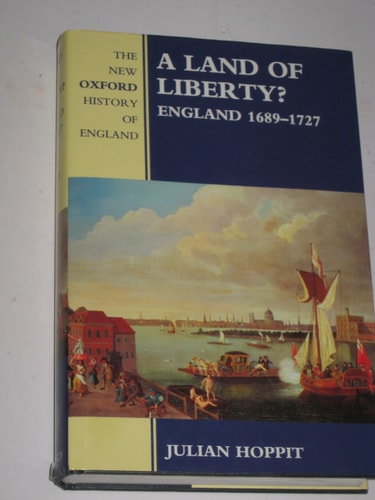
A Land of Liberty?: England 1689-1727
0
0
As an Amazon Associate and affiliate partner, Menrva Books earns from qualifying purchases. Learn more
Author Description
The Glorious Revolution of 1688-9 was a decisive moment in England's history; an invading Dutch army forced James II to flee France, and his son-in-law and daughter, William and Mary, were crowned as joint sovereigns. The wider consequences were no less startling: war in Ireland, union with Scotland, Jacobite intrigue, deep involvement in two major European wars, Britain's emergence as a great power, a 'financial revolution', greater religious toleration, a riven Church, and the rapid growth of parliamentary government.Such changes were only part of the transformation of English society at the time. A torrent of new ideas from such figures as Newton, Defoe, and Addison, spread through newspapers, periodicals, and coffee-houses, provided new views and values that some embraced and others loathed. England's horizons were also growing, especially in the Caribbean and American colonies. For many, however, the benefits were uncertain: the slave trade flourished, inequality widened, and the poor and 'disorderly' were increasingly subject to strictures and statutes. If it was an age of prospects it was also one of anxieties.This new text provides a truly general overview of England between the Glorious Revolution and the death of George I and Newton. Part of the New Oxford History of England series, it is a wide ranging survey that combines the rich secondary literature with extensive primary research. It looks at politics, religion, economy, society, and culture and seeks to place England in its British, European, and world contexts. It includes an annotated bibliography and will prove invaluable to a wide range of students of the period.
Menrva's Summary
THE THESIS
This book investigates the multifaceted transformation of England between the Glorious Revolution of 1688 and the death of George I in 1727, questioning the extent to which the era truly functioned as a 'land of liberty.' Julian Hoppit, a distinguished historian, synthesizes extensive primary research and secondary literature to analyze how political, religious, and economic shifts redefined the English state. He argues that while the period fostered parliamentary growth and intellectual expansion, it simultaneously entrenched social inequalities and colonial exploitation. The work provides a comprehensive framework for understanding how these internal developments positioned England as a rising global power within a broader European context.
THE SCOPE MAP
What You Will Find
- Analysis of the political and constitutional shifts following the Glorious Revolution.
- Examination of the 'financial revolution' and its impact on the English economy.
- Exploration of cultural and intellectual developments involving figures like Newton and Defoe.
- Discussion of social stratification, religious toleration, and the expansion of colonial interests.
- Integration of British, European, and global perspectives on 18th-century statecraft.
THE AUTHORITY PERSPECTIVE
Experts recognize this volume as a foundational survey for students and scholars of the late seventeenth and early eighteenth centuries. Readers frequently note the academic density of the prose and the author's ability to balance complex political narratives with detailed social history.
Page Count:
624
Publication Date:
2000-08-10
Publisher:
Oxford University Press
ISBN-10:
0198228422
ISBN-13:
9780198228424
History
Great Britain
British History
Economic History
Political History
Social History
Community Tags
Similar Books