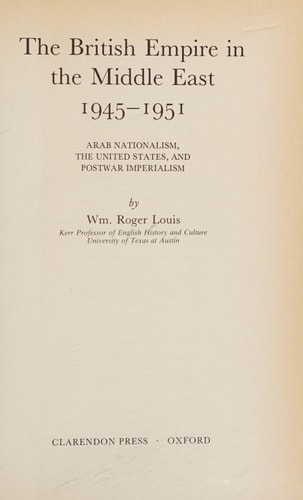
The British Empire in the Middle East, 1945-1951: Arab Nationalism, the United States, and Postwar Imperialism
0
0
As an Amazon Associate and affiliate partner, Menrva Books earns from qualifying purchases. Learn more
Author Description
This is a far-reaching study of how Britain's postwar Labour government attempted to sustain a vision of Britain as a world power. Committed to the liquidation of the old British Empire, the government sought to develop new relationships in the Middle East as a replacement for India, hoping to halt the decline of the Empire by putting it on a new basis. Caught between the forces of anti-British nationalism and American anti-colonialism, the attempt was ultimately destined to fail; but it marks a crucial phase in the story of British imperialism and of Middle Eastern history.
Menrva's Summary
THE THESIS
This work investigates the strategic failure of the British Labour government to maintain its status as a global power in the Middle East during the immediate post-World War II era. Wm. Roger Louis, a distinguished historian of the British Empire, utilizes extensive archival research and diplomatic records to analyze the transition of British influence. He argues that the government's attempt to pivot from its Indian colonial model to a new Middle Eastern framework was undermined by the dual pressures of rising Arab nationalism and the shifting geopolitical interests of the United States. The text provides a detailed examination of the structural limitations of British imperial policy during this period of rapid decolonization.
THE SCOPE MAP
What You Will Find
- Analysis of British foreign policy under the postwar Labour government.
- Examination of the geopolitical tension between British imperial interests and American anti-colonialism.
- Historical documentation of the rise of Arab nationalism across the Middle East.
- Evaluation of the strategic shift in British focus following the loss of India.
THE AUTHORITY PERSPECTIVE
Historians and scholars of international relations frequently cite this work as a definitive account of the complexities inherent in the decline of the British Empire. Readers often note the academic density of the prose, which provides a rigorous and comprehensive analysis of the diplomatic maneuvers that defined the era.
Page Count:
820
Publication Date:
1986-02-06
Publisher:
Oxford University Press
ISBN-10:
0198229607
ISBN-13:
9780198229605
History
International relations
British History
Community Tags
Similar Books