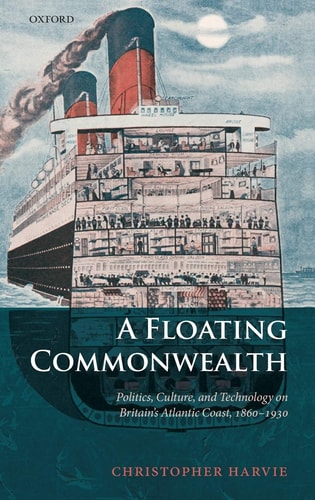
A Floating Commonwealth: Politics, Culture, and Technology on Britain's Atlantic Coast, 1860-1930
0
0
As an Amazon Associate and affiliate partner, Menrva Books earns from qualifying purchases. Learn more
Author Description
Christopher Harvie offers a new portrait of society and identity in high industrial Britain by focusing on the sea as connector, not barrier. Atlantic and 'inland sea' together, Harvie argues, created a "floating commonwealth" of port cities and their hinterlands whose interaction, both with one another and with nationalist and imperial politics, created an intense political and cultural synergy.At a technical level, this produced the freight steamer and the efficient types of railways which opened up the developing world, as well as the institutions of international finance and communications in the age of "telegrams and anger". And ultimately, the resources of the Atlantic cities, their shipyards and works, enabled Britain to win withstand the test of the First World War.Meanwhile, as Harvie shows, the continuous attempt to make sense of an ever-changing material reality also stimulated the discourses on which social criticism and literary modernism were based, from Carlyle to James Joyce -- although the ultimate outcome, of slump and emigration, would leave enduring problems in the years to come.
Menrva's Summary
THE THESIS
This work investigates how the maritime connectivity of Britain's Atlantic coast between 1860 and 1930 functioned as a primary driver for the nation's industrial, political, and cultural development. Christopher Harvie, a historian specializing in British regional and political history, utilizes a synthesis of economic data, technological history, and literary analysis to argue that port cities formed a distinct "floating commonwealth." By examining the synergy between these coastal hubs and their hinterlands, Harvie demonstrates how this network facilitated the expansion of global finance, communications, and imperial power while simultaneously shaping the social conditions that birthed modernism.
THE SCOPE MAP
What You Will Find
- Analysis of the technological evolution of freight steamers and railway infrastructure.
- Examination of the intersection between maritime trade and international finance institutions.
- Discussion of the cultural impact of industrialization on literary modernism and social criticism.
- Historical assessment of how Atlantic port resources sustained Britain during the First World War.
THE AUTHORITY PERSPECTIVE
Scholars and historians recognize this text as a significant contribution to the study of regional identity within the context of high industrial Britain. Readers frequently note the academic density of the prose, which effectively bridges the gap between economic history and cultural studies.
Page Count:
284
Publication Date:
2008-06-02
Publisher:
Oxford University Press
ISBN-10:
0198227833
ISBN-13:
9780198227830
History
Shipping
Political History
Maritime history
Industrial history
British History
Great Britain
Social History
Community Tags
Similar Books