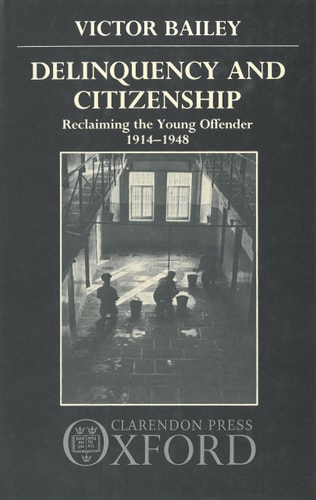
Delinquency and Citizenship: Reclaiming the Young Offender 1914-1948
0
0
As an Amazon Associate and affiliate partner, Menrva Books earns from qualifying purchases. Learn more
Author Description
Drawing on in-depth research and historical case studies, this book looks at the formation, development, and implementation of policy for young offenders between 1914 and 1948 in the context of the welfare activities of modern Britain. Bailey presents detailed discussions not only of the systems--the juvenile court, early probation, the approved schools, and the borstal training system--but also of background of the "liberal progressive" men and women who worked to promote reform during these years.
Menrva's Summary
THE THESIS
This book investigates how the British state and reformist movements redefined the relationship between juvenile delinquency and citizenship during the first half of the twentieth century. Victor Bailey, a historian specializing in social policy and crime, utilizes archival records and institutional histories to examine the evolution of the juvenile justice system. He argues that the shift toward rehabilitative models was driven by a specific class of liberal reformers who sought to integrate young offenders into the national social fabric through state-sponsored welfare and training programs.
THE SCOPE MAP
What You Will Find
- Analysis of the juvenile court system and the expansion of early probation services.
- Historical evaluation of the approved schools and the borstal training system.
- Biographical profiles of the liberal reformers who influenced penal policy between 1914 and 1948.
- Examination of the intersection between social welfare policy and the management of youth deviance in modern Britain.
THE AUTHORITY PERSPECTIVE
Experts recognize this work as a foundational text for understanding the transition from punitive to rehabilitative juvenile justice in the United Kingdom. Readers frequently note the academic density of the prose and the meticulous use of primary source documentation to support the author's historical arguments.
Page Count:
360
Publication Date:
1987-03-26
Publisher:
Oxford University Press
ISBN-10:
0198226640
ISBN-13:
9780198226642
History
British History
Social policy
Sociology
Criminology
Community Tags
Similar Books