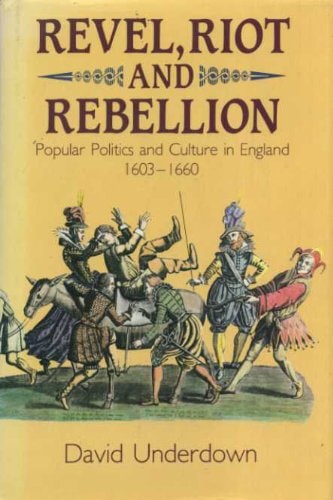
Revel, Riot and Rebellion: Popular Politics and Culture in England 1603-1660
0
0
As an Amazon Associate and affiliate partner, Menrva Books earns from qualifying purchases. Learn more
Author Description
What do maypoles, charivari processions, and stoolball matches have to do with the English civil war? A great deal, argues Underdown in this provocative reinterpretation of the English Revolution. Underdown uses case histories of three western countries to show that the war was, above all, the result of profound disagreements amond people of all social levels about the moral basis of their communities--that commoners as well as rulers held strong opinions about order and governance. Through an original synthesis of social history and popular culture, Underdown links these regionally diverse political opinions to cultural diversity and shows that local differences in popular allegiance in the civil war strikingly coincided with regional contrasts in the traditional festive culture. This pioneering study offers a new understanding of the relationship between society, politics, and culture in 17th-century England.
Menrva's Summary
THE THESIS
This work investigates how regional variations in popular culture and festive traditions influenced political allegiances during the English Civil War. David Underdown, a historian specializing in 17th-century England, utilizes detailed case studies from three western counties to challenge traditional top-down interpretations of the conflict. He argues that the war was fundamentally shaped by deep-seated disagreements among all social classes regarding the moral and communal foundations of English society. By linking local festive customs to political behavior, the author provides a framework for understanding how popular opinion functioned as a catalyst for national revolution.
THE SCOPE MAP
What You Will Find
- Analysis of 17th-century English festive traditions including maypoles, charivari, and sports.
- Comparative case studies of three distinct western English counties.
- Integration of social history methodology with political analysis.
- Examination of the relationship between local cultural identity and national political allegiance.
THE AUTHORITY PERSPECTIVE
Historians frequently cite this work as a foundational text for understanding the intersection of popular culture and political history in early modern England. Scholars note that the author's regional approach provides a necessary corrective to broader, more generalized narratives of the English Revolution.
Page Count:
370
Publication Date:
1986-01-16
Publisher:
Oxford University Press
ISBN-10:
0198227957
ISBN-13:
9780198227953
History
Cultural History
British History
Social History
Political History
Community Tags
Similar Books