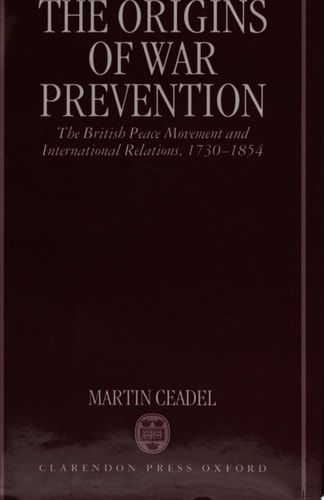
The Origins of War Prevention: The British Peace Movement and International Relations, 1730-1854
0
0
As an Amazon Associate and affiliate partner, Menrva Books earns from qualifying purchases. Learn more
Author Description
This book makes an original contribution to international relations and British politics. It identifies for the first time the dominant pre-modern theory of international relations, which fatalistically assumed that war was beyond human control. It then shows how this theory was undermined from the 1730s onwards, with the consequence that a debate began about how best to prevent war in which a vocal minority argued that war as an institution for settling disputes could be abolished. Britain led the way in this repudiation of fatalism and exploration of pacific alternatives: it produced the world's first peace movement (which appeared in the mid-1790s as a response to the French wars) and the first enduring national peace association (the Peace Society, founded in 1816 and active for nearly a century); and it was the first counbtry to allow peace thinking to enter its political mainstream. This book, the first to make use of the Peace Society's records, fills a major gap in the historiography of British politics.
Menrva's Summary
THE THESIS
This book investigates the historical transition from a fatalistic acceptance of war as an inevitable institution to the emergence of organized movements dedicated to its prevention. Martin Ceadel, a scholar of international relations and British political history, utilizes previously untapped primary source records from the Peace Society to construct his argument. He posits that Britain served as the primary incubator for modern peace theory, tracing the intellectual shift from the 1730s through the mid-19th century. By examining the intersection of political discourse and institutional activism, Ceadel demonstrates how the repudiation of war-fatalism fundamentally altered the landscape of international diplomacy.
THE SCOPE MAP
What You Will Find
- Analysis of the pre-modern theory of international relations regarding the inevitability of conflict.
- A detailed history of the world's first peace movement emerging during the French wars of the 1790s.
- Examination of the Peace Society, founded in 1816, and its influence on British political mainstream.
- Primary source research derived from the internal records of early peace associations.
THE AUTHORITY PERSPECTIVE
Historians and political scientists recognize this work as a foundational text for understanding the origins of organized pacifism in British politics. Scholars frequently cite the book for its meticulous use of archival materials and its significant contribution to the historiography of international relations.
Page Count:
600
Publication Date:
1996-05-23
Publisher:
Clarendon Press
ISBN-10:
0198226748
ISBN-13:
9780198226741
History
Peace studies
International relations
British History
Community Tags
Similar Books