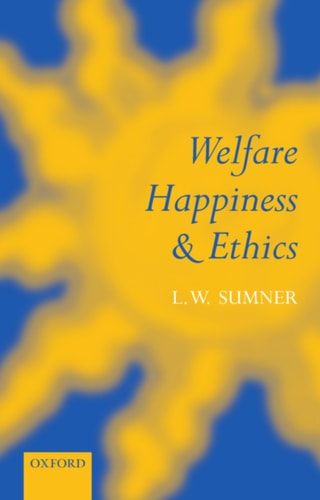
Welfare, Happiness, and Ethics
0
0
As an Amazon Associate and affiliate partner, Menrva Books earns from qualifying purchases. Learn more
Author Description
Moral philosophers agree that welfare matters. But they disagree about what it is, or how much it matters. Wayne Sumner presents an original theory of welfare, investigating its nature and discussing its importance. He considers and rejects all notable theories of welfare, both objective and subjective, including hedonism and theories founded on desire or preference. His own theory connects welfare closely with happiness or life satisfaction. Reacting against the value pluralism that currently dominates moral philosophy, he advances welfare as the only basic ethical value. He concludes by discussing the implications of this thesis for ethical and political theory. Written in clear, non-technical language, and including a definitive survey of other work in this area, Sumner's book is essential reading for moral philosophers, political theorists, and welfare economists.
Menrva's Summary
THE THESIS
This book investigates the fundamental nature of welfare and its central role as the primary ethical value in moral and political philosophy. L. W. Sumner, a prominent moral philosopher, evaluates existing objective and subjective theories of welfare, including hedonism and preference-based models, before ultimately rejecting them. He proposes an original framework that equates welfare with happiness and life satisfaction, arguing for a monistic approach to ethical value. The text bridges the gap between abstract moral theory and practical political application.
THE SCOPE MAP
What You Will Find
- A critical survey of historical and contemporary theories of welfare
- A detailed critique of hedonism and desire-based preference models
- An original argument for welfare as the sole basic ethical value
- Implications for political theory and economic policy
THE AUTHORITY PERSPECTIVE
Experts recognize this work as a significant contribution to the debate on value monism versus pluralism in ethics. Scholars frequently cite the text for its accessible prose and its rigorous systematic approach to defining welfare in a modern context.
Page Count:
256
Publication Date:
1999-04-15
Publisher:
Clarendon Press
ISBN-10:
0198238789
ISBN-13:
9780198238782
Economics
Philosophy
Public welfare
Happiness
Ethics
Contentment
Political Theory
Community Tags
Other Editions(4)



Similar Books