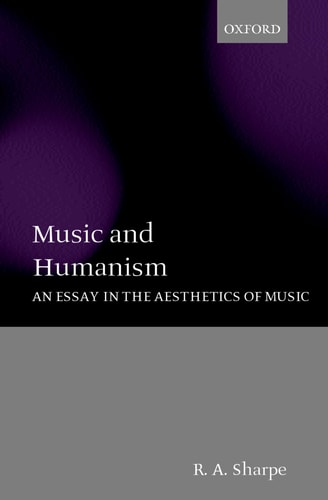
Music and Humanism: An Essay in the Aesthetics of Music
0
0
As an Amazon Associate and affiliate partner, Menrva Books earns from qualifying purchases. Learn more
Author Description
Robert Sharpe examines the humanist conception of music as a language--as expressive and intelligible--which has been a dominant theory in Western culture. He argues against the view that music is expressive by causing certain states in us. Rather, he contends that our beliefs about music are integral to our appreciation of it. Differences in musical taste are then not just irresolvable differences in sensitivity, but the result of variations in circumstance and upbringing, of associations and ideology.
Menrva's Summary
THE THESIS
This work investigates whether music functions as a language capable of conveying intelligible expression rather than merely acting as a stimulus for emotional states. Robert Sharpe, a scholar in the philosophy of music, challenges the prevailing psychological view that music's value lies in its ability to induce specific feelings in the listener. Instead, he proposes a framework where musical appreciation is deeply rooted in our beliefs, cultural context, and ideological associations. By shifting the focus from internal reaction to cognitive understanding, he provides a robust defense of the humanist perspective on musical aesthetics.
THE SCOPE MAP
What You Will Find
- An analysis of the humanist conception of music as a communicative language.
- A critique of the causal theory of musical expression.
- An exploration of how upbringing and social circumstance shape individual musical taste.
- A philosophical examination of the relationship between belief systems and aesthetic judgment.
THE AUTHORITY PERSPECTIVE
Experts in the philosophy of music recognize this text as a significant contribution to the debate surrounding musical meaning and expression. Readers frequently note the clarity of the author's arguments, which serve as a foundational resource for those interested in the intersection of cognitive philosophy and musicology.
Page Count:
240
Publication Date:
2000-08-10
Publisher:
Clarendon Press
ISBN-10:
0198238851
ISBN-13:
9780198238850
Philosophy
Music
Music theory
Aesthetics
Music
Humanism
Community Tags
Similar Books