Unfinished Music
0
0
As an Amazon Associate and affiliate partner, Menrva Books earns from qualifying purchases. Learn more
Author Description
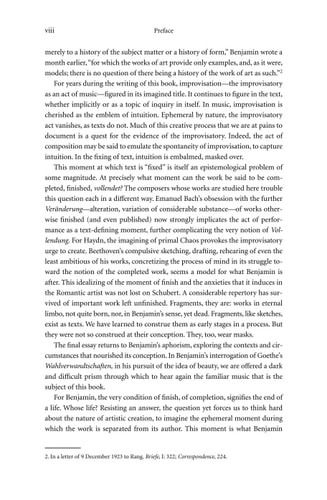
Unfinished Music draws its inspiration from the riddling aphorism by Walter Benjamin that serves as its epigraph: "the work is the death mask of its conception." The work in its finished, perfected state conceals the enlivening process engaged in its creation. An opening chapter of this book examines some explosive ideas from the mind of J. G. Hamann, eccentric figure of the anti-rationalist Enlightenment, on the place of language at the seat of thought. These ideas are pursued as an entry into the no less radical mind of Carl Philipp Emanuel Bach, whose bold idiosyncrasies, like Hamann's, disrupted the discourse of Enlightenment aesthetics. Bach is a central player here, his late music the subject of fresh inquiry. In several chapters on the late music of Beethoven, Bach reappears, now something of a spiritual alter ego in the search for a new voice. The improvisatory as a mode of thought figures prominently here, and then inspires a new hearing of the envisioning of Chaos at the outset of Haydn's Creation, aligned with Herder's efforts to come to an understanding of logos at the origin of thought. The improvisatory is at the heart of a chapter on Beethoven's brazen cadenzas for the Concerto in D minor by Mozart, another ghost in Beethoven's machine.Music seductively unfinished is the topic of other chapters: on some unstudied late sketches, finally rejected, for a famous quartet movement by Beethoven; on the enigmas set loose in several remarkable Mozart fragments; and on the romanticizing of fragment and its bearing on two important sonatas that Schubert left incomplete. In a final coming to terms with the imponderables of musical intuition, the author returns to Benjamin's epigraph, drawing together his foundational essay on Goethe's Elective Affinities with Thomas Mann's Death in Venice, and with a draft for a famous passage in the andantino of Schubert's Sonata in A (1828). Unfinished Music explores with subtle insight the uneasy relationship between the finis
Menrva's Summary
THE THESIS
This book investigates the philosophical and aesthetic tension between the finalized musical work and the creative process that precedes it, positing that the finished score often obscures the vital, improvisatory nature of its own conception. Richard Kramer, a distinguished musicologist, utilizes the writings of Walter Benjamin, J. G. Hamann, and Johann Gottfried von Herder to construct a framework for understanding musical intuition. By analyzing the works of C.P.E. Bach, Beethoven, Haydn, Mozart, and Schubert, the author argues that the 'unfinished' or fragmentary state of a composition reveals more about the composer's cognitive process than the polished final product.
THE SCOPE MAP
What You Will Find
- Analysis of late-period musical sketches and rejected drafts by Beethoven and Schubert.
- Philosophical exploration of the 'improvisatory' as a mode of musical thought.
- Comparative study of Enlightenment-era aesthetics and their influence on 18th and 19th-century composition.
- Examination of specific musical fragments and cadenzas as evidence of the creative struggle.
THE AUTHORITY PERSPECTIVE
Experts in musicology recognize this text as a sophisticated, dense inquiry into the intersection of German philosophy and classical music composition. Readers frequently note that the prose requires a high level of familiarity with both music theory and the intellectual history of the Enlightenment to fully grasp the author's nuanced arguments.
Page Count:
405
Publication Date:
2008-04-16
Publisher:
Oxford University Press
ISBN-10:
0195326822
ISBN-13:
9780195326826
Philosophy
Music
Music
Music History
Music theory
Aesthetics
Community Tags
Other Editions(3)

Similar Books

Reader Comments
Share Your Thoughts
No comments yet. Be the first to share your thoughts!