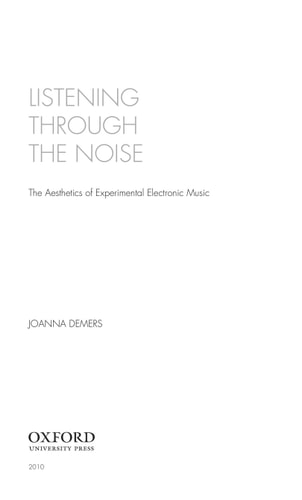
Listening through the Noise: The Aesthetics of Experimental Electronic Music
0
0
As an Amazon Associate and affiliate partner, Menrva Books earns from qualifying purchases. Learn more
Author Description
Electronic music since 1980 has splintered into a dizzying assortment of genres and subgenres, communities and subcultures. Given the ideological differences among academic, popular, and avant-garde electronic musicians, is it possible to derive an aesthetic theory that accounts for this variety? And is there even a place for aesthetics in twenty-first-century culture? This book explores genres ranging from techno to electroacoustic music, from glitch to drone music, and from dub to drones, and maintains that culturally and historically informed aesthetic theory is not only possible but indispensable for understanding electronic music.The abilities of electronic music to use preexisting sounds and to create new sounds are widely known. This book proceeds from this starting point to consider how electronic music changes the way we listen not only to music, but to sound itself. The common trait in recent experimental electronic music is a concern with whether sound, in itself, bears meaning. The use of previously undesirable materials like noise, field recordings, and extremely quiet sounds has contributed to electronic music's destruction of the "musical frame", the conventions that used to set apart music from the outside world. In the void created by the disappearance of the musical frame, different philosophies for listening have emerged. Some electronic music genres insist upon the inscrutability and abstraction of sound. Others maintain that sound functions as a sign pointing to concepts or places beyond the work. But all share an approach towards listening that departs fundamentally from the expectations that have governed music listening in the West for the previous five centuries.
Menrva's Summary
THE THESIS
Can a coherent aesthetic theory be established to account for the vast, fragmented landscape of electronic music produced since 1980? Joanna Demers, a musicologist specializing in contemporary sound, argues that despite the ideological divides between academic, popular, and avant-garde practitioners, a historically informed aesthetic framework is necessary to interpret the medium. She posits that electronic music fundamentally alters human perception by challenging traditional boundaries between musical composition and ambient noise.
THE SCOPE MAP
What You Will Find
- Analysis of diverse electronic genres including techno, electroacoustic, glitch, drone, and dub.
- Examination of the shift from traditional musical structures to the use of noise and field recordings.
- Theoretical exploration of how electronic music dismantles the conventional musical frame.
- Discussion on the philosophical implications of sound as an abstract entity versus a signifier of external concepts.
THE AUTHORITY PERSPECTIVE
Scholars and music critics frequently cite this work as a foundational text for understanding the intersection of sound studies and contemporary electronic composition. Readers often note the academic density of the prose, which provides a rigorous intellectual framework for analyzing non-traditional auditory experiences.
Page Count:
216
Publication Date:
2010-07-30
Publisher:
Oxford University Press
ISBN-10:
0195387651
ISBN-13:
9780195387650
Philosophy
Music
Humanities
Technology
Music
Avant-garde
Music theory
Aesthetics
Criticism history
Community Tags
Similar Books