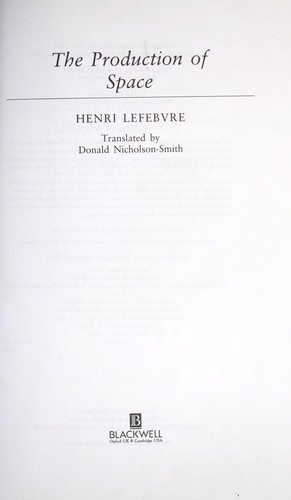
La production de l'espace
0
0
As an Amazon Associate and affiliate partner, Menrva Books earns from qualifying purchases. Learn more
Author Description
Henri Lefebvre has considerable claims to be the greatest living philosopher. His work spans some sixty years and includes original work on a diverse range of subjects, from dialectical materialism to architecture, urbanism and the experience of everyday life. The Production of Space is his major philosophical work and its translation has been long awaited by scholars in many different fields. The book is a search for a reconciliation between mental space (the space of the philosophers) and real space (the physical and social spheres in which we all live). In the course of his exploration, Henri Lefebvre moves from metaphysical and ideological considerations of the meaning of space to its experience in the everyday life of home and city. He seeks, in other words, to bridge the gap between the realms of theory and practice, between the mental and the social, and between philosophy and reality. In doing so, he ranges through art, literature, architecture and economics, and further provides a powerful antidote to the sterile and obfuscatory methods and theories characteristic of much recent continental philosophy. This is a work of great vision and incisiveness. It is also characterized by its author's wit and by anecdote, as well as by a deftness of style which Donald Nicholson-Smith's sensitive translation precisely captures.--Publisher description.
Menrva's Summary
THE THESIS
THE THESIS
Henri Lefebvre's seminal work investigates the complex relationship between mental and physical space, seeking to reconcile abstract philosophical conceptions of space with the lived realities of the social and physical world. Drawing on decades of work across dialectical materialism, architecture, and everyday life, Lefebvre critically examines how space is produced, perceived, and experienced. He argues for a unified understanding of space that bridges the gap between theory and practice, the mental and the social, and philosophy and lived reality. The book offers a powerful critique of abstract philosophical methods, advocating for a more grounded and integrated approach to understanding the human condition within its spatial context.
THE SCOPE MAP
- What You Will Find:
- Exploration of the dialectics between mental space (conceived) and real space (lived).
- Analysis of the production of space through social, economic, and political forces.
- Examination of the experience of space in everyday life, including home and city.
- Integration of concepts from art, literature, architecture, and economics.
- Critique of abstract and obfuscatory philosophical methods.
- A framework for understanding the social production of space.
THE AUTHORITY PERSPECTIVE
THE AUTHORITY PERSPECTIVE
This work is recognized as a foundational text in urban studies and social theory, highly anticipated for its English translation. Scholars across various disciplines acknowledge Lefebvre's significant contributions to understanding the production and experience of space. The book is lauded for its ambitious scope, bridging theoretical philosophy with concrete social realities. Its incisive analysis and distinctive style are noted as providing a valuable counterpoint to more abstract philosophical discourse.
Page Count:
454
Publication Date:
1991-01-01
ISBN-10:
0631140484
ISBN-13:
9780631140481
Non-Fiction
Philosophy
Social Theory
Urban Studies
Community Tags
Similar Books