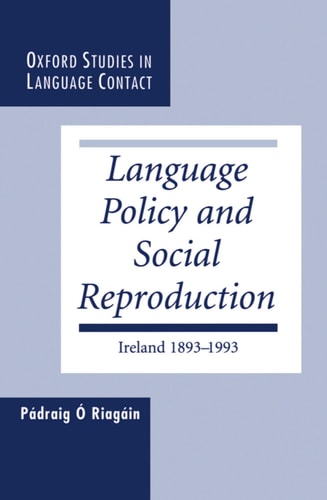
Language Policy and Social Reproduction: Ireland, 1893-1993
0
0
As an Amazon Associate and affiliate partner, Menrva Books earns from qualifying purchases. Learn more
Author Description
During the nineteenth century, Irish-speaking communities declined almost to the point of extinction. But in 1922 the new Irish state launched a broad strategy to re-establish Irish as a national language. This book looks at that policy and its impact over the last seventy years. Pádraig Ó Riagáin focuses not only on the evolving structure of bilingualism in Ireland but also on the process of bilingual reproduction. His analysis is based on a series of language surveys conducted between 1973 and 1993.
Menrva's Summary
THE THESIS
This book investigates the efficacy and social consequences of the Irish state's century-long effort to revive the Irish language as a primary national medium. Pádraig Ó Riagáin, a prominent researcher in language planning, utilizes a longitudinal framework to examine the transition from nineteenth-century decline to twentieth-century state-sponsored revitalization. By synthesizing demographic data and sociological theory, the author evaluates how bilingualism is maintained or lost within social structures over several generations.
THE SCOPE MAP
What You Will Find
- Longitudinal analysis of Irish language usage from 1893 to 1993.
- Sociological framework for understanding the process of bilingual reproduction.
- Empirical data derived from a series of language surveys conducted between 1973 and 1993.
- Evaluation of state-led language policy and its impact on community-level linguistic habits.
THE AUTHORITY PERSPECTIVE
Experts recognize this work as a foundational text for understanding the intersection of state policy and linguistic survival in post-colonial contexts. Readers frequently note the academic density of the prose and the rigorous reliance on survey data to support the author's conclusions.
Page Count:
320
Publication Date:
1997-07-10
Publisher:
Clarendon Press
ISBN-10:
0198235186
ISBN-13:
9780198235187
History
Linguistics
Irish language
Language Policy
Ireland
Sociology
Language And Culture
Community Tags
Similar Books