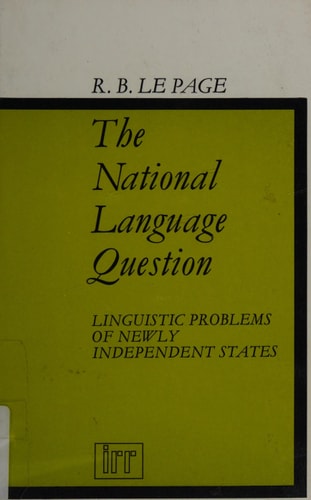
The National Language Question
0
0
As an Amazon Associate and affiliate partner, Menrva Books earns from qualifying purchases. Learn more
Author Description
A national language is more than a mere administrative it can be a sign of cultural unity, or, where no such unity exists, a means towards it and thus towards a sense of national identity. In the new nation-states of today, many of which are regions with no natural unity, the official language must also be the channel of communication between often very disparate groups; and diversity of language impedes the nation's economic and educational progress as well as it's unity. But the choice of an official national language raises many problems, not only of linguistics but also of politics, anthropology, psychology and of sociology.This book discusses these problems both in their more general aspects (with many examples) and in relation to two India, a country of various languages, but a common cultural history, and Malaysia, a new state whose many language groups reflect its diversity of cultures.
Menrva's Summary
THE THESIS
This work investigates the complex interplay between language policy, national identity, and the socio-political challenges inherent in establishing an official national language within diverse nation-states. R.B. Le Page, a noted linguist, examines how language serves as both a tool for administrative cohesion and a potential source of friction in regions lacking natural cultural unity. By synthesizing perspectives from linguistics, psychology, and political science, the author argues that the selection of a national language is a multifaceted process that significantly impacts economic and educational development.
THE SCOPE MAP
What You Will Find
- Analysis of the role of language in fostering national identity
- Comparative study of India and Malaysia as case studies
- Examination of the intersection between linguistic diversity and state progress
Scope Limits
- Does not provide a universal solution for all multilingual nations
- Focuses primarily on the mid-20th-century context of post-colonial nation-building
THE AUTHORITY PERSPECTIVE
Scholars in the field of sociolinguistics recognize this text as a foundational exploration of the political dimensions of language planning. Readers frequently note that the prose is accessible yet maintains a high level of academic rigor regarding the challenges of state-building in diverse societies.
Page Count:
88
Publication Date:
1964-01-01
Publisher:
OXFORD UNIV + PRESS
ISBN-10:
0192181475
ISBN-13:
9780192181473
Anthropology
Linguistics
Language Policy
Reference
Sociology
Foreign Study
Community Tags
Similar Books