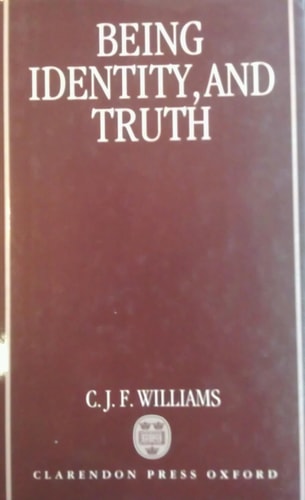
Being, Identity, and Truth
0
0
As an Amazon Associate and affiliate partner, Menrva Books earns from qualifying purchases. Learn more
Author Description
Philosophers have met with many problems in discussing the interconnected concepts being, identity, and truth, and have advanced many theories to deal with them. Williams argues that most of these problems and theories result from an inadequate appreciation of the ways in which the words "be," "same," and "true" work. By means of linguistic analysis he shows that being and truth are not properties, and identity is not a relation. He is thus able to demystify a number of metaphysical issues concerning the meaning of the word "I," the relation between the mental and the physical, objects of thought, times and places, and the nature of reality. Williams presents his views clearly, with a minimum of technicality, and with rich and apt examples, so that they will be accessible to readers not versed in symbolic logic.
Menrva's Summary
THE THESIS
This work investigates the fundamental philosophical confusion surrounding the concepts of being, identity, and truth by examining the linguistic functions of their corresponding terms. C. J. F. Williams, a scholar of philosophy, posits that many traditional metaphysical dilemmas arise from a misunderstanding of how the words "be," "same," and "true" operate in language. By applying rigorous linguistic analysis, the author argues that being and truth are not properties and that identity is not a relation. This framework serves to demystify complex metaphysical debates regarding the self, the mind-body problem, and the nature of reality.
THE SCOPE MAP
What You Will Find
- Linguistic analysis of the terms "be," "same," and "true"
- Re-evaluation of metaphysical problems concerning the "I" and mental-physical relations
- Examination of objects of thought, temporal, and spatial concepts
- Accessible explanations designed for readers without a background in symbolic logic
THE AUTHORITY PERSPECTIVE
Experts and readers frequently note the clarity of Williams's prose, which avoids excessive technical jargon to make complex philosophical arguments accessible. The text is often cited as a useful resource for those seeking to understand the intersection of language and metaphysics without requiring advanced training in symbolic logic.
Page Count:
240
Publication Date:
1992-08-20
Publisher:
Clarendon Press
ISBN-10:
0198239718
ISBN-13:
9780198239710
Philosophy
Linguistic Philosophy
Ontology
Truth
Epistemology
Logic
Metaphysics
Identity Philosophical concept
Community Tags
Similar Books