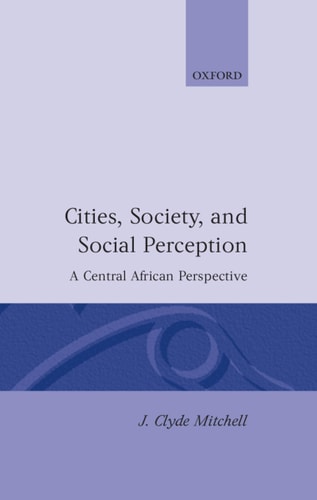
Cities, Society, and Social Perception: A Central African Perspective
0
0
As an Amazon Associate and affiliate partner, Menrva Books earns from qualifying purchases. Learn more
Author Description
A dramatic consequence of the impact of Western capitalism on countries to which it has turned for raw materials and export markets has been the spectacular growth of cities in developing regions. Drawing on empirical material assembled during his twenty-one years in Africa, Mitchell here uses statistical analysis to investigate changing urban conditions in South Central Africa and their wider social, political, and economic contexts. This comparative study provides a unique springboard for an examination of the way in which urban sociologists and anthropologists think about urban phenomena in general.
Menrva's Summary
THE THESIS
This work investigates the socio-economic drivers and consequences of rapid urban growth in South Central Africa resulting from the expansion of Western capitalism. J. Clyde Mitchell, an experienced sociologist and anthropologist with over two decades of field research in the region, utilizes rigorous statistical analysis to map the transformation of urban environments. He argues that the development of these cities cannot be understood in isolation, but must be viewed through the lens of broader global economic pressures and local social structures. By synthesizing empirical data, the author provides a framework for understanding the complex interplay between individual social perception and large-scale urban phenomena.
THE SCOPE MAP
What You Will Find
- Longitudinal empirical data collected over twenty-one years of field research in South Central Africa.
- Statistical methodologies applied to urban migration, social stratification, and economic integration.
- Comparative analysis of urban development patterns in developing regions under capitalist influence.
- Theoretical frameworks for evaluating how social perception shapes urban identity and political organization.
THE AUTHORITY PERSPECTIVE
Scholars and urban sociologists frequently cite this text as a foundational study for understanding the intersection of colonial economic history and modern urban development in Africa. Experts highlight the author's meticulous use of empirical data as a benchmark for comparative anthropological research in the region.
Page Count:
368
Publication Date:
1987-09-17
Publisher:
Clarendon Press
ISBN-10:
0198232535
ISBN-13:
9780198232537
Economics
Anthropology
Sociology
Cities And Towns
Urban Studies
Africa
Community Tags
Similar Books