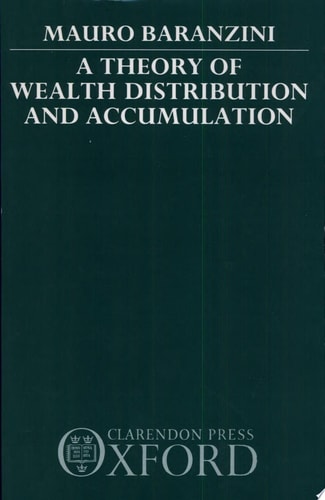
A Theory of Wealth Distribution and Accumulation
0
0
As an Amazon Associate and affiliate partner, Menrva Books earns from qualifying purchases. Learn more
Author Description
This volume provides a general framework for a macroeconomic theory of income distribution and wealth distribution and accumulation. The book is divided into two parts. In the first the author surveys the sets of literature on the subject and relates them to each other. In the second part he makes his own contribution by presenting a new model which uses both neo-classical and post-Keynesian analytical tools. The author focuses on the laws which regulate the behavior of individuals and social groups within a given institutional set-up, and in particular those which regulate the accumulation of inter-generational wealth and life-cycle savings of families or dynasties, both in a deterministic and stochastic context. The theoretical issue of savings accumulation is reconsidered, alongside income distribution, and profit determination by concentrating on the historical reasons that are at the basis of "class distinction," as well as "generation distinction," in modern economic analysis.
Menrva's Summary
THE THESIS
This volume investigates the fundamental macroeconomic mechanisms that govern the distribution of income and the long-term accumulation of wealth across generations. Mauro Baranzini, a noted economist, synthesizes existing literature before proposing a novel analytical model. By integrating neo-classical and post-Keynesian frameworks, the author examines how institutional structures, life-cycle savings, and inter-generational transfers influence economic outcomes in both deterministic and stochastic environments.
THE SCOPE MAP
What You Will Find
- A comprehensive survey of historical and contemporary literature regarding income and wealth distribution.
- A dual-methodology model utilizing both neo-classical and post-Keynesian analytical tools.
- Analysis of savings behavior within families and dynasties across different generations.
- Examination of the relationship between profit determination and class-based economic distinctions.
THE AUTHORITY PERSPECTIVE
Experts recognize this work as a rigorous contribution to the field of distribution theory, particularly for its synthesis of disparate economic schools of thought. Readers frequently note the technical density of the prose, which is intended for advanced students and professional economists interested in formal modeling.
Page Count:
288
Publication Date:
1991-02-28
Publisher:
Clarendon Press
ISBN-10:
0198233132
ISBN-13:
9780198233138
Economics
Wealth
Macroeconomics
Economic Theory
Finance
Community Tags
Similar Books