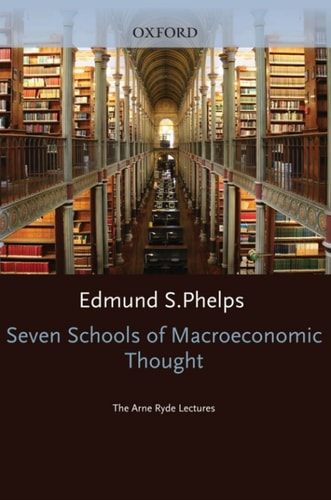
Seven Schools of Macroeconomic Thought: The Arne Ryde Memorial Lectures
0
0
As an Amazon Associate and affiliate partner, Menrva Books earns from qualifying purchases. Learn more
Author Description
This book offers an excellent survey of various macroeconomic topics which feature prominently in the research agenda and have inspired both theoretical and policy debate. The book presents an authoritative and comprehensive summary and original critique of modern macroeconomic approaches by a scholar whose own contribution to the field is considerable. In each of his seven chapters, the author reviews one school of economic thought. These are: the Keynesian school of macroeconomics; the monetarist school; the New Classical school; the New-Keynesian school; supply side macroeconomics, and `non-monetary' models of macroeconomics - the real business cycle theory and the `structuralist school' which views changes in unemployment as the outcome of shifts in the structural characteristics of the economy. The book is the text of the first series of Ryde Lectures, established by Lund University in Sweden.
Menrva's Summary
THE THESIS
This book investigates the foundational frameworks and divergent methodologies of seven distinct schools of macroeconomic thought. Edmund S. Phelps, a Nobel laureate in Economics, utilizes his extensive background in structuralist theory to provide a rigorous evaluation of modern economic paradigms. The text synthesizes complex theoretical developments into a comparative analysis, assessing how each school addresses policy debates and research agendas.
THE SCOPE MAP
What You Will Find
- Detailed analysis of the Keynesian, Monetarist, New Classical, and New-Keynesian schools.
- Examination of supply side macroeconomics and real business cycle theory.
- Exploration of the structuralist school regarding unemployment and economic shifts.
Scope Limits
- The text focuses primarily on the theoretical frameworks presented in the original 1990s lecture series.
- It does not provide an exhaustive history of economic thought prior to the mid-20th century.
THE AUTHORITY PERSPECTIVE
Experts recognize this work as a foundational text for understanding the evolution of macroeconomic debate through the lens of a primary contributor to the field. Readers frequently note the academic density of the prose, which is best suited for students and professionals familiar with intermediate economic theory.
Page Count:
128
Publication Date:
1990-01-01
Publisher:
Clarendon Press
ISBN-10:
0191521280
ISBN-13:
9780191521287
Economics
Economic Theory
Macroeconomics
Principles of Macroeconomics
Academic
Economic History
Community Tags
Similar Books