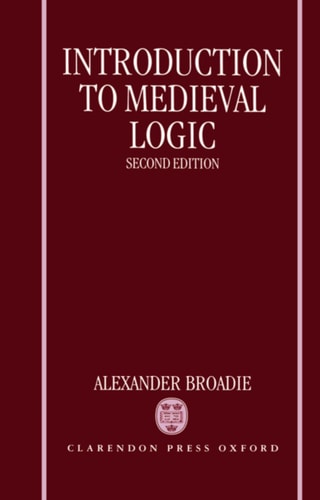
Introduction to Medieval Logic
0
0
As an Amazon Associate and affiliate partner, Menrva Books earns from qualifying purchases. Learn more
Author Description
Medieval logicians advanced far beyond the logic of Aristotle, and this book shows how far that advance took them in two central areas. Broadie focuses upon the work of some of the great figures of the fourteenth century, including Walter Burley, William Ockham, John Buridan, Albert of Saxony, and Paul of Venice, and deals with their theories of truth conditions and validity conditions. He reveals how much of what seems characteristically twentieth-century logic was familiar long ago. Broadie has extensively revised his text for this second edition, while preserving the character of the first. There are now fuller accounts of supposition, of intentional contexts, and of medieval syllogistic, and the conclusion has been substantially expanded.
Menrva's Summary
THE THESIS
This book investigates the extent to which medieval logicians expanded upon Aristotelian frameworks, specifically regarding truth and validity conditions. Alexander Broadie, a scholar of medieval philosophy, utilizes the writings of prominent fourteenth-century thinkers to demonstrate the sophistication of scholastic logic. By analyzing the works of figures such as William Ockham and John Buridan, the author argues that many concepts often attributed to modern logic were already well-developed in the medieval period. The text serves as a bridge between historical scholasticism and contemporary analytical logic.
THE SCOPE MAP
What You Will Find
- Analysis of fourteenth-century logical theories including supposition and intentional contexts.
- Examination of the works of Walter Burley, William Ockham, John Buridan, Albert of Saxony, and Paul of Venice.
- Detailed exploration of medieval syllogistic structures and their evolution.
- Comparative study of medieval truth conditions versus modern logical standards.
THE AUTHORITY PERSPECTIVE
Experts recognize this work as a foundational text for understanding the technical rigor of scholastic logic. Readers frequently note the academic density of the prose, which requires a baseline familiarity with philosophical terminology to fully grasp the arguments presented.
Page Count:
226
Publication Date:
1993-06-24
Publisher:
Clarendon Press
ISBN-10:
0198240260
ISBN-13:
9780198240266
Philosophy
Logic Medieval
Academic
Logic
Community Tags
Other Editions(3)


Similar Books