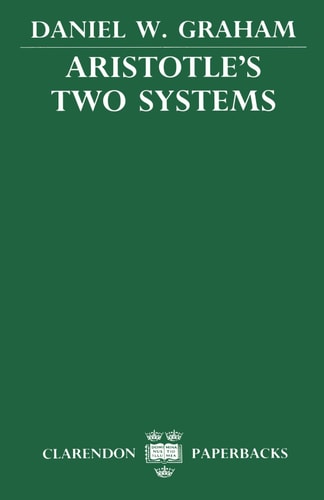
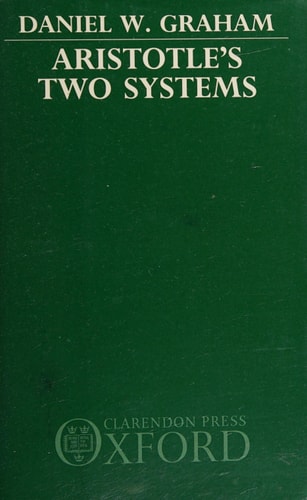
Aristotle's Two Systems
0
0
As an Amazon Associate and affiliate partner, Menrva Books earns from qualifying purchases. Learn more
Author Description
Each of the two major approaches to Aristotle--the unitarian, which understands his work as forming a single, unified system, and the developmentalist, which seeks a sequence of developing ideas--has inherent limitations. This book proposes a synthetic view of Aristotle that sees development as a change between systematic theories. Setting theories of the so-called logical works beside theories of the physical and metaphysical treatises, Graham shows that Aristotle's doctrines fall into two distinct systems of philosophies that are genetically related.
Menrva's Summary
THE THESIS
This book investigates whether Aristotle's philosophical output represents a single unified system or a sequence of evolving ideas, ultimately proposing a synthetic model. Daniel W. Graham, a scholar of ancient philosophy, utilizes a comparative analysis of Aristotle's logical, physical, and metaphysical treatises to argue for a dual-system framework. By examining the genetic relationship between these distinct philosophical phases, Graham provides a methodology for reconciling the unitarian and developmentalist schools of thought. The work serves as a rigorous re-evaluation of Aristotelian scholarship through the lens of systematic change.
THE SCOPE MAP
What You Will Find
- A comparative analysis of Aristotle's logical works versus his physical and metaphysical treatises.
- A critical evaluation of the unitarian and developmentalist interpretations of Aristotelian thought.
- A proposed synthetic model of philosophical development as a transition between systematic theories.
- Detailed examination of the genetic links between disparate Aristotelian doctrines.
THE AUTHORITY PERSPECTIVE
Scholars and students of ancient philosophy frequently cite this text as a significant contribution to the ongoing debate regarding the coherence of Aristotle's corpus. Readers often note the academic density of the prose, which requires a foundational understanding of Aristotelian terminology to fully grasp the author's arguments.
Page Count:
384
Publication Date:
1990-12-06
Publisher:
Clarendon Press
ISBN-10:
0198243154
ISBN-13:
9780198243151
Philosophy
Aristotle
Metaphysics
Logic
Academic
Community Tags
Other Editions(3)

Similar Books