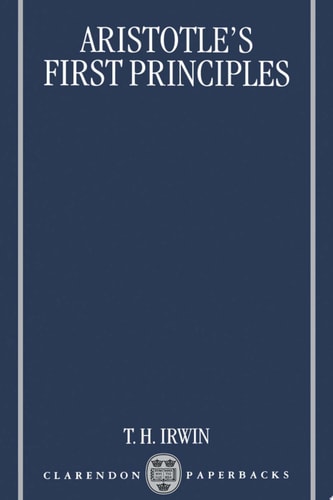
Aristotle's First Principles
0
0
As an Amazon Associate and affiliate partner, Menrva Books earns from qualifying purchases. Learn more
Author Description
Exploring Aristotle's philosophical method and the merits of his conclusions, Irwin here shows how Aristotle defends dialectic against the objection that it cannot justify a metaphysical realist's claims. He focuses particularly on Aristotle's metaphysics, epistemology, philosophy of mind, and ethics, stressing the connections between doctrines that are often discussed separately.
Menrva's Summary
THE THESIS
This work investigates how Aristotle constructs his philosophical method to defend metaphysical realism against the challenges posed by dialectical inquiry. Terence Irwin, a prominent scholar of ancient philosophy, utilizes a rigorous analytical framework to examine the internal consistency of Aristotelian thought. By synthesizing disparate areas of the philosopher's work, Irwin argues that Aristotle's conclusions are not isolated observations but are deeply interconnected components of a unified system. The text provides a systematic reconstruction of the logical foundations supporting Aristotle's claims in metaphysics, epistemology, and ethics.
THE SCOPE MAP
What You Will Find
- Analysis of the defense of dialectic against skeptical objections
- Examination of the relationship between metaphysical realism and epistemological justification
- Integration of Aristotelian ethics with his philosophy of mind
- Systematic mapping of connections between Aristotle's core doctrines
THE AUTHORITY PERSPECTIVE
Scholars and students of ancient philosophy frequently cite this text as a rigorous, high-level examination of Aristotelian methodology. Experts highlight the book's success in bridging the gap between Aristotle's metaphysical claims and his practical ethical theories.
Page Count:
720
Publication Date:
1989-02-16
Publisher:
Oxford University Press
ISBN-10:
0198247176
ISBN-13:
9780198247173
Philosophy
Epistemology
Metaphysics
Aristotle
Ethics
Methodology
Community Tags
Other Editions(3)

Similar Books