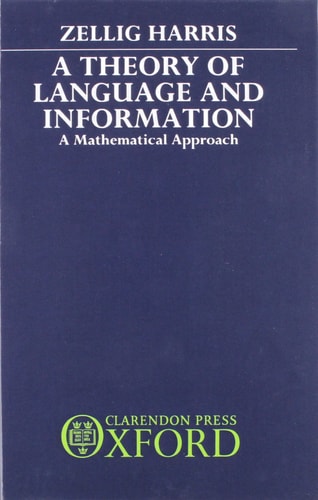
A Theory of Language and Information: A Mathematical Approach
0
0
As an Amazon Associate and affiliate partner, Menrva Books earns from qualifying purchases. Learn more
Author Description
Written by one of the most respected figures in American linguistics, this book develops an approach to the analysis of language on a mathematical model. Harris presents a formal theory of language structure, in which syntax is characterized as an orderly system of departure from random combinings of sounds, words, and all the elements of language. He argues that the combining of words in a sentence constitutes a mathematical object, and that each departure from randomness is a contribution to the structure and meaning of a sentence. Discussing the differences in the structure and content of language, mathematics, and music, Harris shows that the use of language in a science constitutes a distinguishable sub-language. Remarkable and compelling, Harris's magnum opus will be considered the classical analysis of the structuring of information and development of language.
Menrva's Summary
THE THESIS
This work investigates whether the structure of language can be formally modeled as a mathematical system defined by departures from randomness. Zellig Harris, a foundational figure in American structural linguistics, utilizes his extensive background in formal analysis to propose that syntax functions as an orderly system. He argues that the combination of linguistic elements into sentences creates a mathematical object, where each deviation from random arrangement contributes to the overall structure and semantic content of the communication.
THE SCOPE MAP
What You Will Find
- A formal mathematical model for analyzing linguistic syntax and structure.
- Comparative analysis between the structural properties of language, mathematics, and music.
- Theoretical framework defining the concept of sub-languages within scientific discourse.
- Quantitative approach to measuring information density through non-random element combination.
THE AUTHORITY PERSPECTIVE
Experts recognize this text as a seminal contribution to structural linguistics and the formalization of language analysis. Readers frequently note the high level of academic density and the rigorous, abstract nature of the mathematical proofs presented throughout the volume.
Page Count:
448
Publication Date:
1991-04-11
Publisher:
Clarendon Press
ISBN-10:
0198242247
ISBN-13:
9780198242246
Science
Linguistics
Information Theory
Mathematics
Community Tags
Similar Books