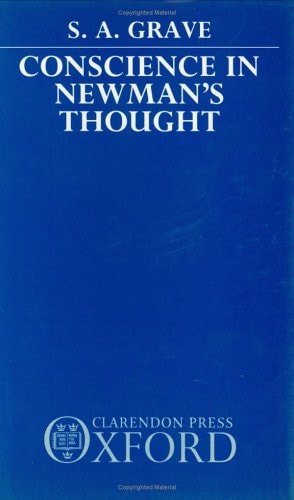
Conscience in Newman's Thought
0
0
As an Amazon Associate and affiliate partner, Menrva Books earns from qualifying purchases. Learn more
Author Description
This authoritative study explores the relation of John Henry Newman's idea of conscience to what he called conscience "in the ordinary sense of the word." Grave argues that a proper understanding of this distinction is essential to a satisfactory understanding of Newman's thought wherever the notion of conscience enters into it. He examines some neglected difficulties in this area such as the relation between individual conscience and the authority of the church, and the matter of rights of conscience.
Menrva's Summary
THE THESIS
This study investigates the precise conceptual distinction between John Henry Newman's specialized theological definition of conscience and its common, colloquial usage. S. A. Grave, a scholar of Newman's philosophical framework, analyzes how this distinction serves as a foundational element for interpreting Newman's broader arguments. By examining the intersection of individual moral agency and ecclesiastical authority, the author provides a rigorous analysis of the tensions inherent in Newman's ethical system. The text utilizes Newman's own writings to clarify the often-misunderstood nuances of his moral philosophy.
THE SCOPE MAP
What You Will Find
- A detailed analysis of the distinction between conscience as a moral faculty and conscience as a social or religious construct.
- Examination of the conflict between individual conscience and the institutional authority of the church.
- Discussion regarding the rights of conscience within a theological framework.
- A critical review of neglected philosophical difficulties in Newman's primary texts.
THE AUTHORITY PERSPECTIVE
Scholars and theologians identify this work as a precise, focused examination of Newman's moral philosophy. Readers frequently note the academic density of the prose, which is intended for those already familiar with Newman's core theological arguments.
Page Count:
200
Publication Date:
1989-12-07
Publisher:
Oxford University Press
ISBN-10:
0198248563
ISBN-13:
9780198248569
Biography
Philosophy
Ethics
Conscience
Theology
Community Tags
Similar Books