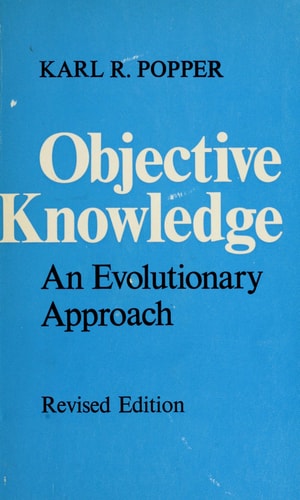
Objective Knowledge: An Evolutionary Approach
0
0
As an Amazon Associate and affiliate partner, Menrva Books earns from qualifying purchases. Learn more
Author Description
The essays in this volume represent an approach to human knowledge that has had a profound influence on many recent thinkers. Popper breaks with a traditional commonsense theory of knowledge that can be traced back to Aristotle. A realist and fallibilist, he argues closely and in simple language that scientific knowledge, once stated in human language, is no longer part of ourselves but a separate entity that grows through critical selection.
Menrva's Summary
THE THESIS
This work investigates the nature of scientific knowledge by proposing that it exists as an objective entity independent of the human mind. Karl R. Popper, a prominent philosopher of science, challenges the traditional Aristotelian view of knowledge as a subjective state of belief. By applying an evolutionary framework, he argues that theories grow and evolve through a process of critical selection, functioning similarly to biological organisms in their adaptation to the environment.
THE SCOPE MAP
What You Will Find
- An evolutionary model of knowledge growth through trial and error.
- A critique of traditional epistemology and the justification of belief.
- The distinction between subjective knowledge and objective knowledge (World 3).
- Philosophical arguments regarding realism and fallibilism.
THE AUTHORITY PERSPECTIVE
Experts recognize this text as a foundational contribution to 20th-century philosophy of science, particularly regarding the autonomy of scientific theories. Readers often note the clarity of Popper's prose despite the complex epistemological subject matter presented throughout the volume.
Page Count:
395
Publication Date:
1979-01-01
Publisher:
Oxford University Press
ISBN-10:
0198243707
ISBN-13:
9780198243700
Philosophy
Science
Epistemology
Evolutionary Theory
Knowledge Theory
Community Tags
Similar Books