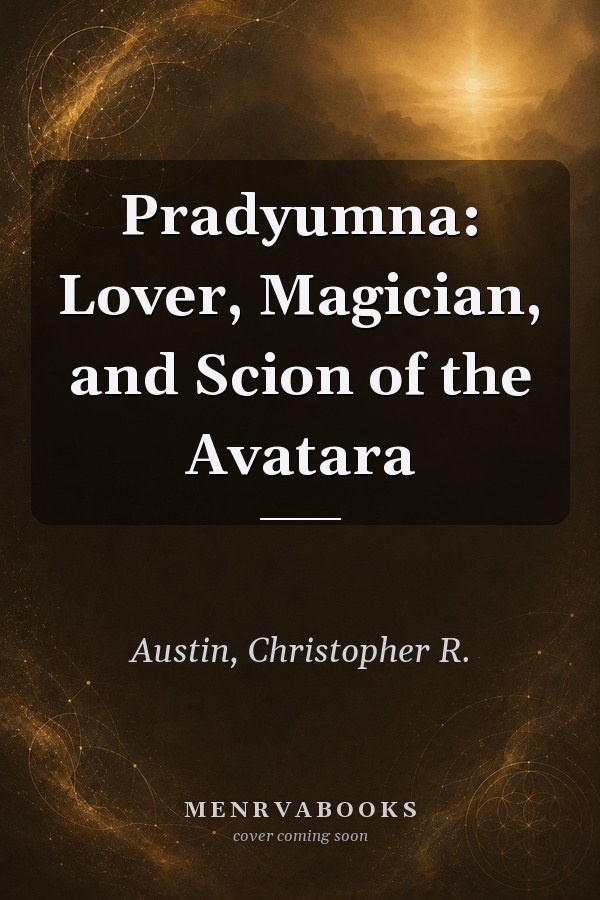
Pradyumna: Lover, Magician, and Scion of the Avatara
0
0
As an Amazon Associate and affiliate partner, Menrva Books earns from qualifying purchases. Learn more
Author Description
This monograph provides the first full-scale English language study of Pradyumna, the son of the Hindu god Krsna. Often represented as a young man in mid-adolescence, Pradyumna is both a handsome double of his demon-slaying father and the rebirth of Kamadeva, the God of Love. Narratives found in the Sanskrit epics, Puranas and kavya works of the 300-1300 CE period celebrate Pradyumna's sexual potency, mastery of illusory subterfuges, and military prowess in supporting the work of his avatara father. These materials reflect chiefly the values of an evolving Brahminical and Vaisnava tradition deeply invested in the imperatives of family, patriline, the violent but necessary defense of the social and cosmic order, and the celebration of beauty and desire as a means to the divine. As such Pradyumna's evolving narratives, almost completely unknown in existing studies of Hindu mythology, provide a point of access to the development of Krsna bhaksi and Vaisuava theism more broadly. However, Jain sources cast Pradyumna as an exemplary figure through whom a pointed rejection of these values can be articulated, even while sharing certain of their elementary premises. Pradyumna: Lover, Magician, and Scion of the Avatara assembles these narratives, presents key Sanskrit materials in translation and summary form, and articulates the social, gender and religious values encoded in them. Most importantly, the study argues that Pradyumna's signature two-handed maneuver-the audacious appropriation of a feminine partner, effectuating and enabled by the emasculating destruction of her demonic male protector-communicates a persisting fantasy of male power expressed in the language of a mutually implicated sex and violence.
Menrva's Summary
THE THESIS
This monograph investigates the mythological and theological significance of Pradyumna, the son of the Hindu god Krsna, to understand his role in the development of Vaisnava theism. Christopher R. Austin, a scholar of South Asian religious traditions, utilizes a wide array of Sanskrit epics, Puranas, and kavya literature from the 300-1300 CE period. He argues that Pradyumna serves as a critical lens through which to examine evolving Brahminical values, including the dynamics of patrilineal power, the defense of cosmic order, and the intersection of desire and divinity.
THE SCOPE MAP
What You Will Find
- Analysis of Sanskrit texts from the 300-1300 CE period.
- Comparative study of Brahminical, Vaisnava, and Jain perspectives on Pradyumna.
- Examination of the recurring narrative motif involving the appropriation of a female partner and the defeat of a demonic protector.
Scope Limits
- The study focuses primarily on the textual evolution of Pradyumna and does not provide an exhaustive history of all Krsna-related deities.
- The analysis is restricted to the specific time period of 300-1300 CE and does not cover modern interpretations or contemporary ritual practices.
THE AUTHORITY PERSPECTIVE
Scholars recognize this work as a significant contribution to the study of Hindu mythology, specifically for its focus on a previously under-researched figure. Readers frequently note the academic density of the prose and the rigorous nature of the textual analysis provided by the author.
Page Count:
432
Publication Date:
2019-01-01
Publisher:
Oxford University Press
ISBN-10:
0190054123
ISBN-13:
9780190054120
History
Religion
Mythology
Hinduism
Literary Criticism