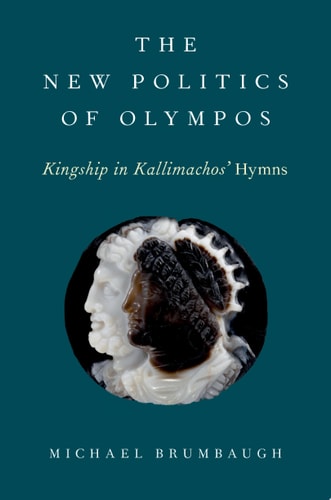
The New Politics of Olympos: Kingship in Kallimachos' Hymns
0
0
As an Amazon Associate and affiliate partner, Menrva Books earns from qualifying purchases. Learn more
Author Description
The New Politics of Olympos explores the dynamics of praise, power, and persuasion in Kallimachos' hymns, detailing how they simultaneously substantiate and interrogate the radically new phenomenon of Hellenistic kingship taking shape during Kallimachos' lifetime. Long before the Ptolemies invested vast treasure in establishing Alexandria as the center of Hellenic culture and learning, tyrants such as Peisistratos and Hieron recognized the value of poetry in advancing their political agendas. Plato, too, saw the vast power inherent in poetry, and famously advocated either censoring it (Republic) or harnessing it (Laws) for the good of the political community. As Xenophon notes in his Hieron and Pindar demonstrates in his politically charged epinikian hymns, wielding poetry's power entails a complex negotiation between the poet, the audience, and political leaders. Kallimachos' poetic medium for engaging in this dynamic, the hymn, had for centuries served as an unparalleled vehicle for negotiating with the super-powerful.The New Politics of Olympos offers the first in-depth analysis of Kallimachos' only fully extant poetry book, the Hymns, by examining its contemporary political setting, engagement with a tradition of political thought stretching back to Homer, and portrayal of the poet as an image-maker for the king. In addition to investigating the political dynamics in the individual hymns, this book details how the poet's six hymns, once juxtaposed within a single bookroll, constitute a macro-narrative on the prerogatives of Ptolemaic kingship. Throughout the collection Kallimachos refigures the infamously factious divine family as a paradigm of stability and good governance in concert with the self-fashioning of the Ptolemaic dynasty. At the same time, the poet defines the characteristics and behaviors worthy of praise, effectively shaping contemporary political ethics. Thus, for a Ptolemaic reader, this poetry book may have served as an education in and inducem
Menrva's Summary
THE THESIS
This book investigates how Kallimachos utilizes the genre of the hymn to navigate, substantiate, and critique the evolving nature of Hellenistic kingship within the Ptolemaic dynasty. Michael Brumbaugh, a scholar of classical literature, analyzes the six extant hymns of Kallimachos to argue that they function as a cohesive macro-narrative. By situating these poems within their historical and political context, the author demonstrates how the poet acted as an image-maker who simultaneously defined political ethics and modeled stability for contemporary rulers.
THE SCOPE MAP
What You Will Find
- Analysis of the six extant hymns of Kallimachos as a unified bookroll.
- Examination of the historical intersection between Hellenistic kingship and poetic patronage.
- Comparative study of political thought from Homer and Pindar to Plato and Xenophon.
- Investigation into the rhetorical strategies used to refigure divine mythology as a paradigm for governance.
Scope Limits
- The analysis is restricted to the six extant hymns of Kallimachos and does not provide a comprehensive biography of the poet.
- The text focuses primarily on the political dimensions of the work rather than a purely aesthetic or linguistic critique.
THE AUTHORITY PERSPECTIVE
Scholars recognize this work as a significant contribution to the study of Hellenistic poetry and its role in political discourse. Readers frequently note the academic density of the prose, which is intended for specialists in classical philology and ancient political history.
Page Count:
320
Publication Date:
2019-10-30
Publisher:
Oxford University Press
ISBN-10:
0190059265
ISBN-13:
9780190059262
Poetry
Ancient History
Social History
Literary Criticism
New Used & Rental Textbooks
Criticism history