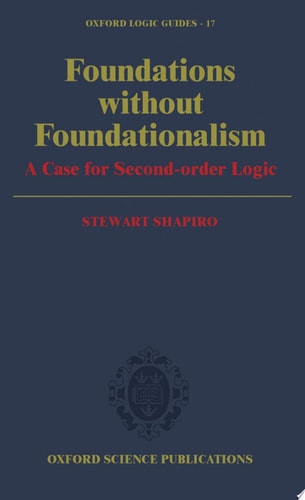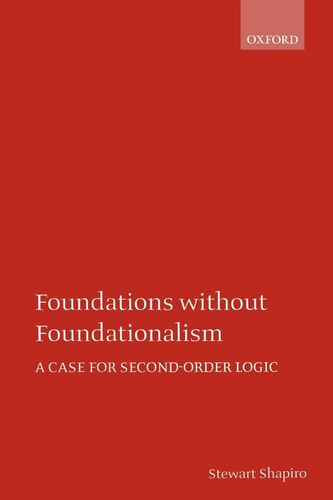
Foundations without Foundationalism: A Case for Second-Order Logic
0
0
As an Amazon Associate and affiliate partner, Menrva Books earns from qualifying purchases. Learn more
Author Description
The central contention of this book is that second-order logic has a central role to play in laying the foundations of mathematics. In order to develop the argument fully, the author presents a detailed description of higher-order logic, including a comprehensive discussion of its semantics. He goes on to demonstrate the prevalence of second-order concepts in mathematics and the extent to which mathematical ideas can be formulated in higher-order logic. He also shows how first-order languages are often insufficient to codify many concepts in contemporary mathematics, and thus that both first- and higher-order logics are needed to fully reflect current work. Throughout, the emphasis is on discussing the associated philosophical and historical issues and the implications they have for foundational studies. For the most part, the author assumes little more than a familiarity with logic comparable to that provided in a beginning graduate course which includes the incompleteness of arithmetic and the Lowenheim-Skolem theorems. All those concerned with the foundations of mathematics will find this a thought-provoking discussion of some of the central issues in the field today.
Menrva's Summary
THE THESIS
This book investigates the role of second-order logic in providing a robust foundation for mathematics, challenging the traditional reliance on first-order logic. Stewart Shapiro, a prominent philosopher of mathematics, utilizes his expertise to argue that higher-order logic is necessary to capture the full scope of contemporary mathematical practice. By examining the limitations of first-order languages, the author constructs a framework that integrates both first- and higher-order systems to better reflect the complexity of mathematical thought.
THE SCOPE MAP
What You Will Find
- A comprehensive technical description of higher-order logic and its formal semantics.
- Comparative analysis between first-order and second-order logical systems.
- Historical and philosophical context regarding the foundations of mathematics.
- Evidence demonstrating the insufficiency of first-order logic for codifying modern mathematical concepts.
THE AUTHORITY PERSPECTIVE
Experts recognize this work as a significant contribution to the philosophy of mathematics, particularly for its clear articulation of the utility of second-order logic. Readers frequently note that the text requires a graduate-level familiarity with logic, specifically regarding the incompleteness of arithmetic and the Lowenheim-Skolem theorems.
Page Count:
304
Publication Date:
2000-05-18
Publisher:
Oxford University Press
ISBN-10:
0198250290
ISBN-13:
9780198250296
Philosophy
Mathematics
Logic
Charitable Uses Trusts And Foundations
Academic