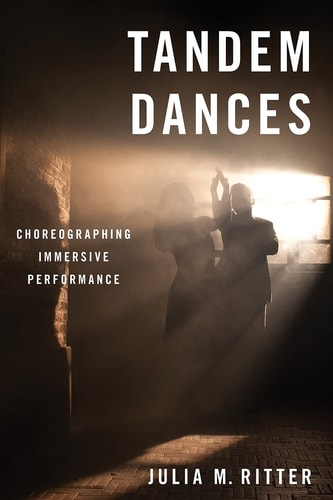
Tandem Dances: Choreographing Immersive Performance
0
0
As an Amazon Associate and affiliate partner, Menrva Books earns from qualifying purchases. Learn more
Author Description
Tandem Dances: Choreographing Immersive Performance is the first book to propose dance and choreography as frames through which to examine immersive theatre, more broadly known as immersive performance. Indicative of a larger renaissance in storytelling during the digital age, immersive performance is influenced by emerging computer technologies, such as virtual reality and advances in video-gaming, as well as increased interest in new forms of experiential entertainment. The idea of tandemness ― suggesting motion that is achieved by two bodies working together and acting in conjunction with one another ― is critical throughout the book. Author Julia M. Ritter persuasively argues that practitioners of immersive productions deploy choreography as a structural mechanism to mobilize the bodies of cast and audience members to perform together. Furthermore, choreography is contextualized as an effective tool for facilitating audience participation towards immersion as an affect. Through a focus on Western dance histories, theories, and practices, Ritter's close choreographic analysis of immersive productions, along with unique insights from choreographers, directors, performers, and spectators, enlivens discourse across dramaturgy, kinesthesia, affect, and co-authorship. By foregrounding the choreographic in order to examine its specific impact on the evolution of immersive theater, Tandem Dances explores choreography as a discursive domain that is fundamentally related to creative practice, agendas of power and control, and concomitant issues of freedom and agency.
Menrva's Summary
THE THESIS
This book investigates the role of choreography as a primary structural mechanism for facilitating immersion and audience participation within the field of immersive theater. Julia M. Ritter, a scholar in dance and performance studies, utilizes a framework rooted in Western dance history and theory to analyze how movement dictates the relationship between performers and spectators. By examining the concept of 'tandemness,' the author argues that choreography functions as a tool for managing agency, power, and co-authorship in experiential performance environments.
THE SCOPE MAP
What You Will Find
- Analysis of immersive theater through the lens of dance and choreographic theory
- Examination of the 'tandemness' concept in collaborative performance
- Insights derived from interviews with directors, choreographers, and performers
- Exploration of the intersection between digital technology and physical movement
Scope Limits
- The text focuses primarily on Western dance histories and performance traditions
- It does not provide a comprehensive history of all immersive theater genres
THE AUTHORITY PERSPECTIVE
Scholars and practitioners identify this work as a significant contribution to the intersection of dance studies and contemporary theater. Readers frequently note the academic rigor of the text, highlighting its utility for those interested in the mechanics of audience engagement and kinesthetic theory.
Page Count:
288
Publication Date:
2020-11-01
Publisher:
Oxford University Press
ISBN-10:
0190051310
ISBN-13:
9780190051310
Dance
Choreography
Humanities - Theatre - General
Dramaturgy
Modern
Immersive Performance
New Used & Rental Textbooks
Theater